New Issue: Orbital Catastrophe Ahead? Read Now

Poem: ‘Weight’

Science in meter and verse

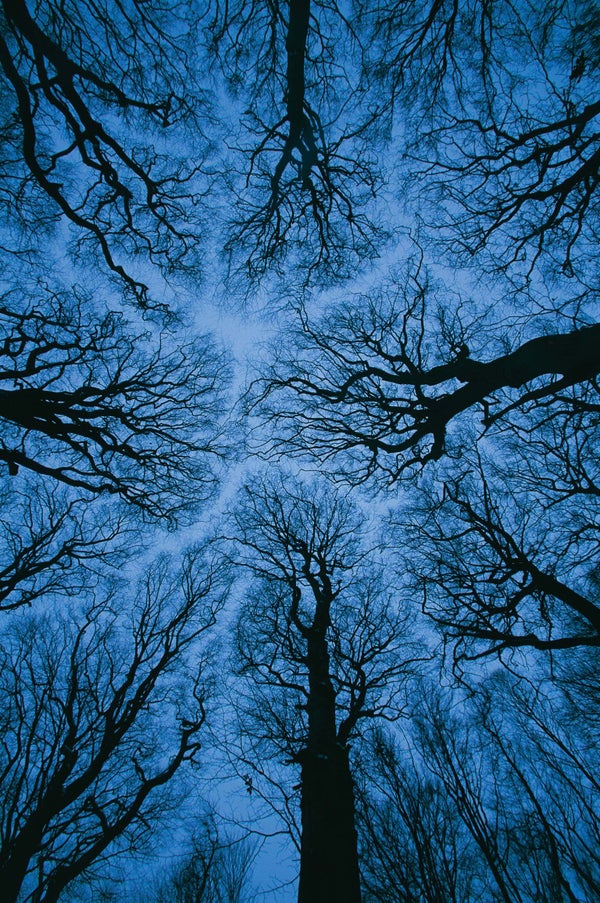
Blue sky seen through tree tops.

Christian Ziegler/Minden Pictures

Edited by Dava Sobel.

1. HOMO SAPIENS

We think the world belongs to us
but scientists have weighed life
on Earth, which turns out to be


On supporting science journalism

If you're enjoying this article, consider supporting our award-winning journalism by subscribing. By purchasing a subscription you are helping to ensure the future of impactful stories about the discoveries and ideas shaping our world today.


mostly trees. Only one hundredth
of the living swim the seven seas.
One-eighth are buried: bacteria.

Underground bacteria weigh more
than a thousand times more than us.
Even worms outweigh us, three to one.

So does the lowly virus.
Humans comprise a mere hundredth of a hundredth
of the living, .01%.

Yet we have paved the earth with chicken bones.
Weep into your soup: under a third of birds
fly free—the rest, poultry.

Garden turned feedlot
and slaughterhouse—we, Homo sapiens,
one-third of all mammals, keep

almost two-thirds to eat, mostly cow
and pig. Only four percent left
for all wild animals, elephant to shrew.

Half of Earth's creatures
have vanished in the last half-century
while we've redoubled.

Even half-gone, plants outweigh us seventy-five hundred to one.

2. THE OTHER FOUR PERCENT

I let the cat out—
I felt the cat
hunkered in her fur

eyes bright in the dark
amidst all the wild things
crouched in their night

tygers to mice
the tiny remnant left
each one fighting for its life.

Author's Note: Proportions are based on percentages of biomass, not numbers of creatures. Source: “The Biomass Distribution on Earth,” by Yinon M. Bar-On, Rob Phillips and Ron Milo, in PNAS; June 19, 2018.

Barbara Ungar's forthcoming collection of poems is After Naming the Animals. Her other published collections include Save Our Ship; Immortal Medusa; Charlotte Brontë, You Ruined My Life; and The Origin of the Milky Way. She is a professor of English at the College of St. Rose in Albany, N.Y.

More by Barbara Ungar
Scientific American Magazine Vol 328 Issue 1This article was published with the title “Weight” in Scientific American Magazine Vol. 328 No. 1 (), p. 22
doi:10.1038/scientificamerican0123-22

Subscribe to Support Independent Journalism

Great science journalism requires human expertise, time, effort and creativity. And it costs money. That’s why I and the journalists here at Scientific American hope you’ll join our community.

When you subscribe, you are supporting staff and freelance journalists who are passionate about telling science stories that are true, important and compelling. Our editors and reporters are often experts in their fields, which means they understand the nuances of big discoveries and can untangle the breakthroughs from the hype. With a subscription, you are also supporting rigorous fact-checking to ensure the words we publish are precise and accurate. And you’re supporting original illustrations, graphics and photos that bring you closer to an advanced laboratory, an ice sheet in Antarctica or a space mission in orbit. You’re helping us craft other types of high-quality journalism as well: Our newsletters are carefully written, edited and curated by staffers you have or will come to know and love. Our Science Quickly podcast is based on original reporting, collaboration with editors and scientists and exacting production.

Subscriptions keep this engine running so we can continue to deliver thoughtful, rigorous and independent science journalism to you. In an era of viral misinformation, this work is crucial. If you value what we do, I hope you’ll consider joining us as a subscriber

Thank you,

Jeanna Bryner, Editor in Chief, Scientific American

Subscribe