New Issue: Orbital Catastrophe Ahead? Read Now

Poems: ‘The Southern Lights at –50° Fahrenheit’ and ‘Lake Vostok’

Science in meter and verse

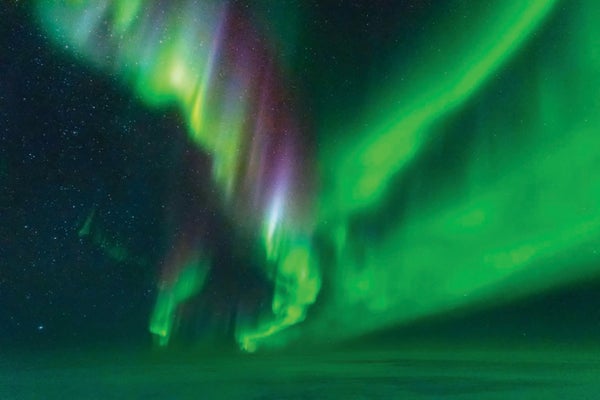
Image of the Southern Lights.

James Stone/Alamy Stock Photo

Edited by Dava Sobel

1. THE SOUTHERN LIGHTS AT –50° FAHRENHEIT —a zeitgeber

When winds were bearable, we sought bliss,
sat, admired the aurora australis
as an escape from our blackest abyss.


On supporting science journalism

If you're enjoying this article, consider supporting our award-winning journalism by subscribing. By purchasing a subscription you are helping to ensure the future of impactful stories about the discoveries and ideas shaping our world today.


We gazed up into rarefied air, clear

and pristine in every echelon,
an atmospheric phenomenon,
solar wind collisions of protons

and electrons high in the exosphere.

Who needs Parthenon or Birth of Venus
when blue lights swirl low, pink coronas kiss
clouds, neon greens arc, deep reds stripe across
stars. We invoke healing through kinesis.

2. LAKE VOSTOK —a zeitgeber

Frantic call sent us to the Pole of Cold.
We maneuvered slowly, sought a controlled
approach through shifting drifts in our Hägglund.

At camp, they drilled to 4,000 meters

to contact a subglacial lake and wrangle
accretion ice and microbe samples,
millions and millions of years old, fragile.

After, we warmed ourselves near space heaters.

We could be on Europa, on untold
frozen moons; sort unique species; unfold
the quilt of the cosmos; piece blocks; hold
no bias; embrace the raw edge, uncontrolled.

Author's Note: The rhyme scheme for this form that I invented (based on the term “zeitgeber,” meaning an external cue that affects the way the body is regulated by circadian rhythms or time cycles) is aaabcccbaaaa and represents three months with sun above the horizon, one month of twilight, three months of darkness, one month of twilight, and four months of sun above the horizon.

Paul Brooke is a professor of English at Grand View University in Des Moines, Iowa. His five books of poetry include Sirens and Seriemas (Brambleby, 2015). As a former biologist and naturalist, he co-authored Jaguars of the Northern Pantanal: Panthera onca at the Meeting of the Waters (Academic Press, 2020).

More by Paul Brooke
Scientific American Magazine Vol 329 Issue 1This article was published with the title “‘The Southern Lights at –50° Fahrenheit’ and ‘Lake Vostok’” in Scientific American Magazine Vol. 329 No. 1 (), p. 20
doi:10.1038/scientificamerican0723-20

Subscribe to Support Independent Journalism

Great science journalism requires human expertise, time, effort and creativity. And it costs money. That’s why I and the journalists here at Scientific American hope you’ll join our community.

When you subscribe, you are supporting staff and freelance journalists who are passionate about telling science stories that are true, important and compelling. Our editors and reporters are often experts in their fields, which means they understand the nuances of big discoveries and can untangle the breakthroughs from the hype. With a subscription, you are also supporting rigorous fact-checking to ensure the words we publish are precise and accurate. And you’re supporting original illustrations, graphics and photos that bring you closer to an advanced laboratory, an ice sheet in Antarctica or a space mission in orbit. You’re helping us craft other types of high-quality journalism as well: Our newsletters are carefully written, edited and curated by staffers you have or will come to know and love. Our Science Quickly podcast is based on original reporting, collaboration with editors and scientists and exacting production.

Subscriptions keep this engine running so we can continue to deliver thoughtful, rigorous and independent science journalism to you. In an era of viral misinformation, this work is crucial. If you value what we do, I hope you’ll consider joining us as a subscriber

Thank you,

Jeanna Bryner, Editor in Chief, Scientific American

Subscribe