
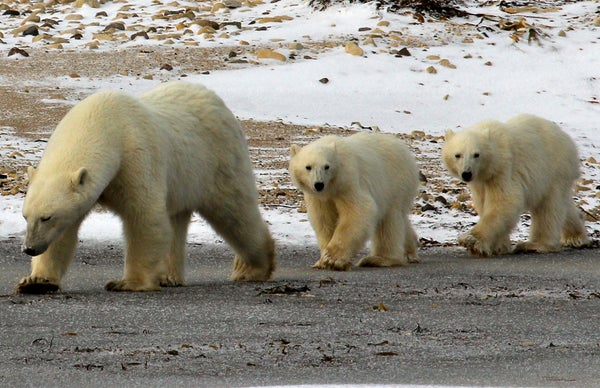
Polar bears are facing trouble inside and out. The animals are losing habitat as global warming melts sea ice. Now a study shows bears’ bodies hold toxic chemicals originally made in distant factories, substances that threaten adult bears’ health at a level 100 times greater than the acceptable threshold of risk for humans. For cubs, the risk is more than 1,000 times that threshold.
These risks have remained high, particularly in cubs, despite restrictions or bans on many of these chemicals more than a decade ago. Whereas the restrictions have reduced overall pollutant levels in cubs, the pace of reduction is being slowed by more recently produced chemicals that are not yet banned, says the study, which was published online in Environmental Toxicology and Chemistry on January 5. “There is definitely a cause for concern,” says Melissa McKinney, a polar bear researcher at the University of Connecticut who was not involved in the study. She says this and other recent research “strongly suggest there’s a very high likelihood of toxicological risk from polar bears’ exposure.” The chemicals could be especially harmful to bears’ ability to reproduce.
These persistent organic pollutants, or POPs, come from industry and reach the Arctic via air or ocean currents. The compounds include older chemicals like PCBs (polychlorinated biphenyls), whose production peaked in the late 1960s and early 1970s, and relatively newer ones including perfluorinated chemicals, which are used in water-resistant fabric coatings and firefighting foam. The pollutants have been linked with reproductive and immune problems in the bears as well as cancer, and their chemical structures make them nearly impossible for organisms to degrade.
On supporting science journalism
If you're enjoying this article, consider supporting our award-winning journalism by subscribing. By purchasing a subscription you are helping to ensure the future of impactful stories about the discoveries and ideas shaping our world today.
Bears accumulate high levels of the chemicals because they are top predators: the compounds build up through the food chain, in plants, fish and finally seals—the bears’ main food source. Many of the compounds are soluble in fat and concentrate there, giving bears a hefty dose of the pollutants when they eat seal blubber. And then the chemicals reach cubs via their mothers’ milk.
For the study, researchers surveyed the literature for levels of 19 POPs in Arctic wildlife, found over a 40-year period.The scientists estimated the bears’ daily exposure to the chemicals based on concentrations in their food—seals for adult bears and milk for nursing cubs. Then the scientists estimated the risk to the bears by comparing these daily exposure amounts with the acceptable daily intake for humans established by the World Health Organization and other agencies. (The toxic effects of the compounds appear similar in polar bears and humans, although the sensitivity of the bears to particular amounts is uncertain.)
Between 1985 and 2010 the overall risk in cubs declined by 30 percent because many of the older chemicals were banned under an international treaty that took effect in 2004. Despite this progress, chemicals produced more recently are keeping the risk high. One of these recent entries is perfluorooctane sulfonate, or PFOS, which has been linked with cancer and has a high tendency to accumulate in the liver. This compound, used to make the fabric protector Scotchgard, peaked in production in the 1990s; today it is restricted but not completely banned. Its levels in adult bears increased exponentially until about 2006, and have since begun to decline after a phaseout of PFOS by Scotchgard manufacturer 3M. Still, the risk to bears remains high because the chemical is toxic at very low concentrations. In 1985 PFOS accounted for about 20 percent of the chemical risk found in polar bear cubs. By 2010, this proportion had climbed to 50 percent.
And replacements for PFOS are now turning up in the animals. An alternative called F-53B, made in China and used in chrome plating, has been found in the bears recently, says Derek Muir, an environmental chemist at Environment Canada, and studies indicate it too is toxic and highly persistent
Given these trends, it is urgent to ban PFOS, says Sara Villa of the University of Milano–Bicocca, an author of the Environmental Toxicology and Chemistry study, and to continue monitoring new chemicals that arise in the Arctic. Although environmental regulations have begun to limit the effects of pollution, she says, the risk the bears face is still far too great.
