
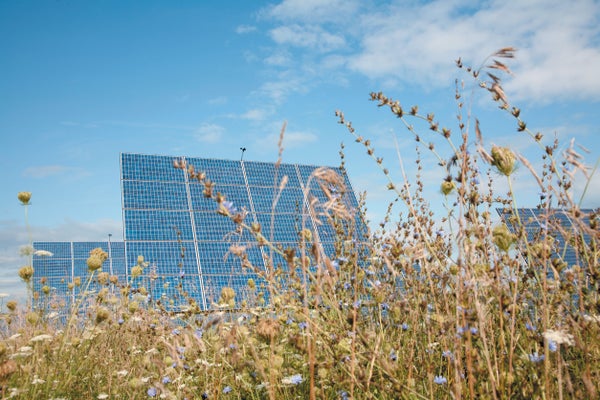
Sprawling plains of solar panels can help nature more than just by providing clean energy: As populations of crucial pollinators decline, developers have been seeding the grounds of their solar arrays with native wildflowers. Now a five-year study published in Environmental Research Letters confirms that this approach boosts the pollinators’ abundance and diversity—with spillover benefits for surrounding farms.
From 2018 through 2022, Argonne National Laboratory landscape ecologist Leroy J. Walston and his colleagues regularly visited two such arrays covering a dozen hectares each in southern Minnesota. The scientists recorded the number and kinds of pollinators the wildflowers attracted and found populations of bees, beetles, butterflies, moths, and more had surged on-site—even as they continued declining elsewhere in the U.S.
Humans’ pesticide use, greenhouse gas emissions and habitat destruction have sparked mass pollinator die-offs. Monarch butterfly numbers, for example, have plummeted by 80 percent nationwide in the past two decades, and according to the Center for Biological Diversity’s 2017 report, nearly one in four native bee species is imperiled and at increasing risk of extinction. Further big losses would be disastrous for ecosystems and agriculture: 75 percent of North American plant species rely on pollinators. The federal government’s energy goals require several million hectares for solar energy, with more than 80 percent of the projects planned for former agricultural land; seeding it this way could help save vanishing pollinators.
On supporting science journalism
If you're enjoying this article, consider supporting our award-winning journalism by subscribing. By purchasing a subscription you are helping to ensure the future of impactful stories about the discoveries and ideas shaping our world today.
During their study, Walston and his team watched goldenrod soldier beetles flourish as their namesake flower, goldenrod, bloomed around the arrays. As other flowers unfurled, a symphony of insects appeared. Native bees saw the most staggering growth, with their population increasing 20-fold by the study’s end. Monarch butterflies also increased in number and fluttered their dappled wings across the sites. Twice as many bees visited soybean fields adjacent to the solar sites as fields farther away, making the nearby plots’ gains comparable to those of locations abutting land enrolled in conservation programs.
Developers have so far been slow to adopt wildflower planting, says Zara Dowling, an ecologist who oversees a pollinator-friendly certification program for solar facilities in Massachusetts. Owners of solar fields are often concerned about the risks of planting and uncertain about the true costs. But Dowling thinks that as incentives emerge and research is refined, it won’t take much of a nudge to make the practice common. “From what I’ve heard,” she says, “a lot of them are willing to do it if they can break even.”
The idea’s efficacy in other parts of the country—such as the desert Southwest—remains to be seen. Nevertheless, as Walston says, at least in the Midwest, “if you plant it, yeah, they’ll come.”