
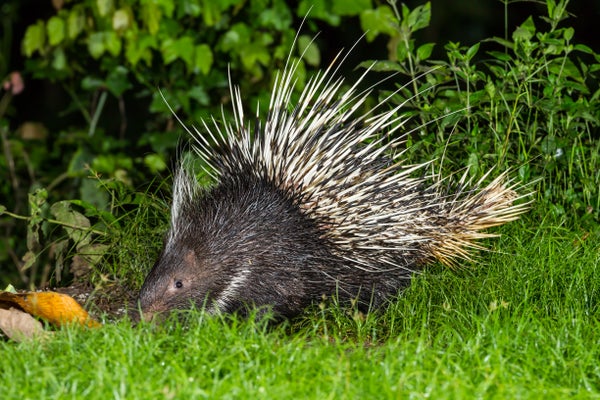
A porcupine’s diet is wide, varied, and a little hard to digest. A lifetime of grasses, herbs, bark and other vegetation can leave little bits of indigestible matter behind in a porcupine’s digestive tract, where they occasionally congeal into a hard ball called a bezoar.
That sounds uncomfortable, but a porcupine’s health probably doesn’t suffer due to the presence of this undigested mass in its stomach or intestines—that is, not until humans come along.
For centuries people have valued these rare “stones” or “dates,” as they’re sometimes called, for their purported healing abilities. Bezoars have been used to “treat” everything from fevers to diabetes and even cancer.
On supporting science journalism
If you're enjoying this article, consider supporting our award-winning journalism by subscribing. By purchasing a subscription you are helping to ensure the future of impactful stories about the discoveries and ideas shaping our world today.
Bezoar use even creeps into popular fiction: the stones are an ingredient for protective spells in the Harry Potter universe.
The medicinal claims are equally fiction: there doesn’t appear to be any veracity to bezoar use to treat illnesses. Yet despite the lack of evidence, the trade in bezoars has persisted. Not only that, it appears to be increasing.
A study published recently in the journal Global Ecology and Conservation tracked, for the first time, the online trade in old-world porcupines (those from the family Hystricidae in Asia and Africa). The researchers examined e-commerce sites in Indonesia, Malaysia and Singapore for four months in 2019, where they found active for-sale listings for 443 individual bezoars and a large variety of powdered products. Based on the weight of the powders, and the assumption that they might have contained other ingredients, the researchers estimate this translated to at least 680 and as many as 1,300 bezoars. (The researcher ignored “out of stock” listings and more dubious sites, such as one that claimed to have 2,000 tons of product on hand.)
Previous research has suggested that bezoars only grow in an incidentally small portion of the porcupine population, so the total number of animals killed to accumulate that quantity for sale could conceivably have been in the tens of thousands.
And since the study didn’t look at the e-commerce sites every day, it probably uncovered only a portion of the total trade.
This paper calls for more study about this issue and additional conservation actions to protect porcupines. Currently the various species enjoy some national-level protection but precious little on the international level, because they’re still perceived as relatively common. In fact, most old-world porcupine species currently appear on the IUCN Red List as either “least concern” or “data deficient.” Only the Philippine porcupine (Hystrix pumila) is listed as “vulnerable to extinction.” None are currently protected by the Convention on Trade in Endangered Species.
Should that change? While the authors acknowledge the limitations caused by their study’s short time frame and their inability to examine and verify the nature of the bezoars (some of which could have come from other animals or been counterfeits), they still uncovered an alarming level of trade. The authors warn that “current trade levels are likely unsustainable, and we predict that porcupine species may become threatened in the future should current trade levels continue.”
And while some porcupines are farmed, this study indicates pressure on wild porcupines, which also face threats from habitat destruction and the bushmeat trade, as well as persecution as agricultural pests. It suggests a need to protect certain populations which fetch higher prices due to their purported purity. The study quotes one popular website: “The most valuable for the porcupine bezoars are procured from … the rainforest of Indonesia or Borneo. The porcupines here eat unpolluted herbs that have high medicinal value causing the bezoars … to be of the rarest and highest value. The price is very high and has collection, medicinal and stockpiling value.”
In many ways this isn’t surprising. The bezoar trade has been around for centuries, and it isn’t restricted to southern Asia. The paper notes that Europeans in the 16th to 19th centuries, who sometimes wore the stones as jewelry, valued porcupine bezoars so much they priced each one “as high as forty times its own weight in gold.”
Bezoars today don’t fetch quite that amount, but the study still found them selling for around $151 a gram—two and a half times the current price of gold—all for a useless clump of congealed, inedible food.
Too bad we don’t value a living porcupine half that much.