
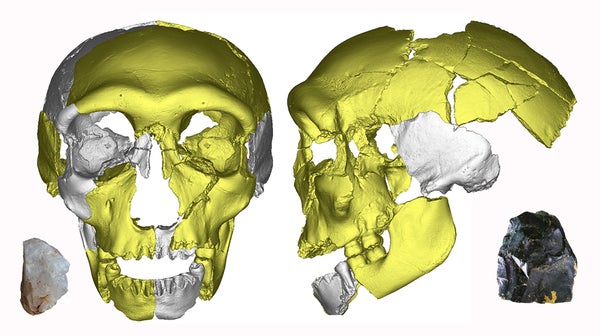
A fossilized jawbone discovered in a cave in eastern China bears a curious mix of ancient and modern features, according to a detailed analysis that compares it with dozens of other human specimens. The finding, published in the Journal of Human Evolution, indicates that the 300,000-year-old bone could have belonged to an as-yet undescribed species of archaic human.
Scientists excavating a cave called Hualongdong, located in Anhui province in eastern China, have unearthed remains of 16 individuals that date to around 300,000 years ago. Several fragments belong to the skull of a 12-to-13-year-old juvenile.
Xiujie Wu, a palaeoanthropologist at the Institute of Vertebrate Paleontology and Paleoanthropology in Beijing, and her colleagues first described the skull in 2019. But in 2020, while sifting through trays of animal bones found in the cave, they identified a fragment of a mandible — the lower part of the jaw — that could be another piece of the same skull.
On supporting science journalism
If you're enjoying this article, consider supporting our award-winning journalism by subscribing. By purchasing a subscription you are helping to ensure the future of impactful stories about the discoveries and ideas shaping our world today.
The discovery has enabled a more detailed analysis of where the Hualongdong people fit on the human family tree. The mandible has a mixture of both modern and archaic features. For example, the bone along the jawline is thick, a feature shared with early human species, such as Homo erectus. It also lacks a true chin, the presence of which is a key feature of Homo sapiens. But the side of the mandible that attaches to the upper jaw is thinner than those of archaic hominins and more reminiscent of that of modern humans.
Ancient and modern
The analysis deepens the mystery of which ancient human species inhabited the region during the Middle to Late Pleistocene epoch, a period spanning almost 800,000 years that preceded the end of the last Ice Age, around 12,000 years ago.
A digital comparison of the newly uncovered mandible with 83 other jawbones confirmed a strange mix of ancient and modern anatomical features. Wu and her colleagues used juvenile and adult bones from Neanderthals (Homo neanderthalensis), which lived in Eurasia until 40,000 years ago, H. sapiens from around the world, and H. erectus, a species whose range extended from eastern Africa to the southeast Asian islands of Indonesia between 1.9 million and 250,000 years ago.
Wu says that the H. sapiens-like features of the jawbone set it apart from those of other hominins from the Middle Pleistocene, including those of a 160,000-year-old Denisovan from Tibet and of the around 770,000-year-old remains known as Peking Man. She adds that the Hualongdong people could represent a previously unknown ancestor or close relative of early H. sapiens.
But the notion that modern humans arose from ancestors in Asia is not widely accepted. The oldest H. sapiens fossils, which date to 230,000 years ago, are from sites in Ethiopia.
Confusing picture
The picture of human occupation in East Asia during the Pleistocene is a confusing one, says Yameng Zhang, a palaeoanthropologist at Shandong University in Jinan, China. He says that numerous species of archaic hominin inhabited East Asia during the Middle Pleistocene, a period from around 800,000 to 126,000 years ago. It is unclear whether any of these could be ancestors of modern humans — like Neanderthals and Denisovans, they might simply have died out.
The combination of ancient and modern features in the Hualongdong mandible is similar to those of remains found during the early 2000s at the Jebel Irhoud archaeological site in Morocco, says María Martinón-Torres, a palaeoanthropologist at the National Research Center on Human Evolution in Burgos, Spain, who was part of the team that described the findings at Hualongdong. The Jebel Irhoud remains — which include several skull fragments and a nearly complete mandible — have an age similar to that of the Hualongdong ones and are thought to belong to one of the earliest members of the evolutionary lineage that includes H. sapiens. “More fossils and studies are necessary to understand [the Hualongdong people’s] precise position in the human family tree,” she says.
Martinón-Torres adds that ancient proteins extracted from the bones could shed further light on how the Hualongdong people are related to modern humans, as well as to more-archaic species.
This article is reproduced with permission and was first published on Septemer 18, 2023.