
If you're a soldier, firefighter or even a hiker, a new soft robotic suit could one day help you carry hefty loads, a new study finds.
The wearable robot, or exosuit, reduces the amount of energy used while carrying a heavy weight by about 7 percent, on average, the researchers found. The suit also reduced the amount of work done by the hip, knee and ankle joints, all without affecting a person's stride, the researchers said.
"The goal wasn't to create a system to give someone superstrength, but rather to provide small levels of assistance during walking over a long period of time, with the goal of reducing fatigue and the risk of injury," said study senior researcher Conor Walsh, a professor at the John A. Paulson School of Engineering and Applied Sciences at Harvard University in Massachusetts. [Bionic Humans: Top 10 Technologies]
On supporting science journalism
If you're enjoying this article, consider supporting our award-winning journalism by subscribing. By purchasing a subscription you are helping to ensure the future of impactful stories about the discoveries and ideas shaping our world today.
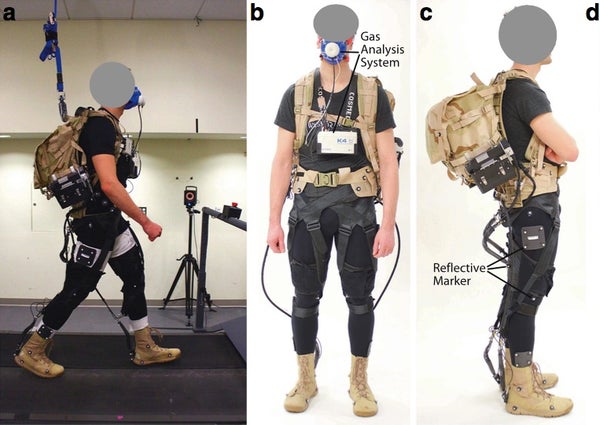
Unlike a rigid exoskeleton or even a flashy Iron-Man-like suit, the exosuit Walsh and his colleagues built consists of textiles and soft materials that attach to a person's legs, waist and back. The soft suit doesn't hinder people's movement, allowing them to walk like they aren't carrying a load at all, the researchers said.
Users simply have to put on a waist belt, two thigh pieces and two calf straps, which are connected by cables to two motors on a backpack. The motors' energy travels through the cables to the suit, and is then transferred back to the person.
This energy then helps the hip and ankle joints, which together provide about 80 percent of the power produced by the leg joints while a person is walking, the researchers said.
To test the suit, the research team examined people moving under three different conditions: while wearing a powered-off suit, while wearing a powered-on suit and while wearing a powered-off suit with the weight of the suit (14 lbs. or 6.5 kilograms) removed from the backpack.
Seven people walked on a treadmill at a constant speed of 3.3 mph (5.4 km/h) while carrying a load equivalent to 30 percent of their weight. The researchers used motion-capture technology and physiological measurements to study how people fared while walking, the investigators said.
Previous research found that muscles in the lower legs work harder when people carry heavy loads, largely to sustain the load and maintain balance, the researchers said. This increased muscle activity is associated with more metabolic cost, which can lead to fatigue, less maneuverability and reduced performance overall. [Watch a Video of the Exosuit in Action]
What's more, people are more likely to injure themselves when they carry heavy loads, the researchers said. And the suit is easy to wear, they added.
"It feels like the muscles in the leg are doing less work, and it becomes very noticeable if the system is turned off very quickly," Walsh told Live Science in an email. What's more, the exosuit could help military personnel, first responders, patients in rehabilitation centers and, of course, hikers, he said.
But don't expect to see the exosuit on sale anytime soon. It's still a research project, and engineers are still tweaking the design, Walsh said.
"A big unknown is how do the muscle and tendons in the body react and adapt to external assistance from a wearable robot," he said. "So, basic science studies that attempt to understand how the wearer’s neuromotor system responds will be important to maximize the benefit that can be achieved."
The study was published online today (May 12) in the Journal of NeuroEngineering and Rehabilitation.
Copyright 2016 LiveScience, a Purch company. All rights reserved. This material may not be published, broadcast, rewritten or redistributed.