
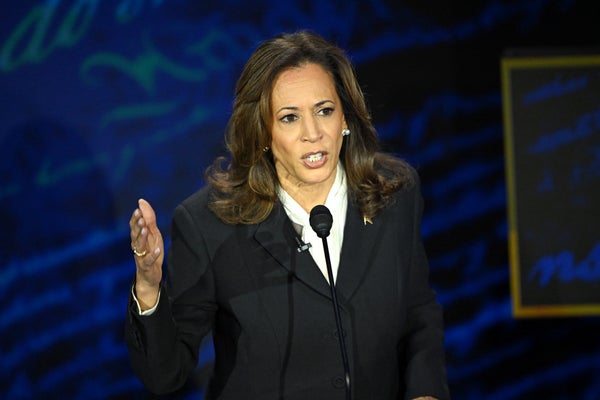
CLIMATEWIRE | Vice President Kamala Harris finally mentioned the climate law she has pointedly avoided on the campaign trail — to prove she won't ban fracking.
“I have not banned fracking as vice president of the United States, and in fact, I was the tie-breaking vote on the Inflation Reduction Act, which opened new leases for fracking,” Harris said at Tuesday night's debate with former President Donald Trump in Philadelphia.
“My position is that we have to invest in diverse sources of energy so we reduce our reliance on foreign oil," she continued. "We have had the largest increase in domestic oil production in history because of an approach that recognizes that we cannot overrely on foreign oil.”
On supporting science journalism
If you're enjoying this article, consider supporting our award-winning journalism by subscribing. By purchasing a subscription you are helping to ensure the future of impactful stories about the discoveries and ideas shaping our world today.
Harris was responding to Trump, who claimed that if she wins the election, "fracking in Pennsylvania will end on day one."
Harris supported a ban on fracking in 2019 but has since reversed her position on the drilling practice, which looms large in gas-rich Pennsylvania. Most paths to winning the presidency include winning the swing state.
The debate — hosted by ABC News at the National Constitution Center — was perhaps the only opportunity for the American public to hear the candidates directly challenge each other on policy ahead of the November election.
Harris dominated much of the debate, taunting Trump on his crowd sizes, his past bankruptcies, his inherited wealth and his stature on the global stage.
Climate change took a backseat to issues like abortion and geopolitics. But Harris worked to define herself on the debate stage as a supporter of both fossil fuels and increased clean energy spending.
She touted the Biden administration's historic investment in clean energy — linking it to "opening up manufacturing around the world" — and pointed to the uptick in climate-fueled extreme weather. And she emphasized Trump's climate denial.
“The former president has said climate change is a 'hoax,' and what we know is that it is very real,” she said.
The debate was an opportunity for Harris to win over undecided voters. A New York Times/Siena College poll released days ago showed that a significant share of voters, 28 percent, feel they need to know more about her before November — compared to just 9 percent who say they need to know more about Trump.
A separate Marist College poll released Tuesday found that 30 percent of voters said the “debate will help them a great deal or good amount in making their selection for president.”
Trump used the debate to bring out the same climate themes that he has touched on frequently during his almost 10 years in political life. He claimed that climate policy kills jobs and destroys manufacturing and that the Inflation Reduction Act is largely a giveaway to China.
He also made dire predictions about a Harris administration.
“Oil will be dead, fossil fuel will be dead,” Trump said. “We'll go back to windmills, and we'll go back to solar, where they need a whole desert to get some energy to come out. You ever see a solar plant? By the way, I'm a big fan of solar, but they take 400, 500 acres of desert soil."
Oil and gas production has soared to historic levels under the Biden administration — a fact Harris pointed out. She also attacked Trump for his conspiratorial energy claims and invited viewers to watch his rallies so they could see for themselves.
“He will talk about how windmills cause cancer,” she said.
On the campaign trail, Trump has promised to both bring back $2 gasoline and decrease inflation by dramatically expanding oil and gas drilling.
But oil and gas prices are set by a global market and largely out of the hands of a president, and economists have said that drilling for more oil will do little to combat inflation.
Harris, meanwhile, has barely mentioned the Biden administration's climate record, which includes the biggest climate spending package in U.S. history and historic investments in clean energy that have created thousands of new jobs.
When she does speak about the Inflation Reduction Act on the campaign trail, she usually touches more on its health care provisions, such as price caps on certain medications.
Harris recently released a policy platform, with a section on energy and climate that does not propose any new specific ideas that differ from Biden’s approach. But on Tuesday, she referenced the importance of climate policy to a crucial demographic: the young voters who were key to Biden's 2020 victory.
“We know that we can actually deal with this issue,” she said of climate change. “The young people of America care deeply about this issue.”
Reprinted from E&E News with permission from POLITICO, LLC. Copyright 2024. E&E News provides essential news for energy and environment professionals.