
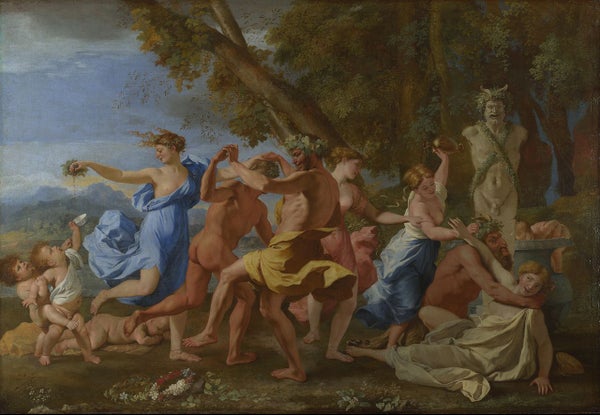

As far as pop culture is concerned, a vomitorium is a room where ancient Romans went to throw up lavish meals so they could return to the table and feast some more. It's a striking illustration of gluttony and waste, and one that makes its way into modern texts. Suzanne Collins' "The Hunger Games" series, for example, alludes to vomitoriums when the lavish inhabitants of the Capitol—all with Latin names like Flavia and Octavia—imbibe a drink to make them vomit at parties so they can gorge themselves on more calories than citizens in the surrounding districts would see in months.
But the real story behind vomitoriums is much less disgusting. Actual ancient Romans did love food and drink. But even the wealthiest did not have special rooms for purging. To Romans, vomitoriums were the entrances/exits in stadiums or theaters, so dubbed by a fifth-century writer because of the way they'd spew crowds out into the streets. [Who Were the Barbarians?]
"It's just kind of a trope," that ancient Romans were luxurious and vapid enough to engage in rituals of binging and purging, said Sarah Bond, an assistant professor of classics at the University of Iowa.
On supporting science journalism
If you're enjoying this article, consider supporting our award-winning journalism by subscribing. By purchasing a subscription you are helping to ensure the future of impactful stories about the discoveries and ideas shaping our world today.
Vomit. Vomitus. Vomitorium.
The Roman writer Macrobius first referred to vomitoriums in his "Saturnalia." The adjective vomitus already existed in Latin, Bond told Live Science. Macrobius added the "orium" ending to turn it into a place, a common type of wordplay in ancient Latin. He was referring to the alcoves in amphitheaters and the way people seemed to erupt out of them to fill empty seats. [Photos: Gladiators of the Roman Empire]
At some point in the late 19th or early 20th century, people got the wrong idea about vomitoriums. It seems likely that it was a single linguistic error: "Vomitorium" sounds like a place where people would vomit, and there was that pre-existing trope about gluttonous Romans.
Classically trained poets and writers at the time would have been exposed to a few sources that painted ancient Romans as just the sort of people who would vomit just to eat more. One source was Seneca, the Stoic who lived from 4 B.C. to A.D. 65 and who gave the impression that Romans were an emetic bunch. In one passage, he wrote of slaves cleaning up the vomit of drunks at banquets, and in his Letter to Helvia, he summarized the vomitorium idea succinctly but metaphorically, referring to what he saw as the excesses of Rome: "They vomit so they may eat, and eat so that they may vomit."
Roman feasts
Another classic was a first-century A.D. piece of satire called the "Satyricon," in which an obnoxiously wealthy man named Trimalchio throws feasts in which he serves dishes like dormice rolled in honey and poppy seeds, a rabbit with wings attached so that it looked like Pegasus, and a huge boar surrounding by suckling pigs, which the guests could take away like party favors. (F. Scott Fitzgerald was so inspired by this work that he originally titled "The Great Gatsby" "Trimalchio in West Egg.")
Writer Aldous Huxley was similarly inspired, and wrote of vomitoriums as literal places to vomit in his 1923 novel "Antic Hay."
"I think it caught on, probably because, A, it's very close to what we already have in terms of the word vomit, so it was easily accessible linguistically and then, B, it already fit in with a cultural perception" spread through works like the "Satyricon," Bond said.
The thing about the "Satyricon," though, is that it was satire—and probably exaggerated. Seneca likewise had a "bad axe to grind about luxury," Bond said. Wealthy Romans and poor Romans ate similar grain-based diets, said Kristina Killgrove, an anthropologist at the University of West Florida, who has studied the diets of ancient Romans through molecular markers left in their teeth. The wealthy ate more wheat; the poor more millet. Richer Romans also got to eat more meat than poorer Romans.
The uber-wealthy did love a good feast, though, Killgrove said. Roman fine dining was a community affair and would have included entertainment like dancers and flutists. Unlike ancient Greeks, Romans included women at their upper-class functions, so crowds would have been co-ed. Historical recipes show a penchant for fanciful presentations of food, particularly meats stuffed inside other meats.
"The Roman upper class really would have loved Turducken," Killgrove told Live Science.
But they probably wouldn't have thrown up that chicken-stuffed-in-a duck-stuffed-in-a-turkey afterward.
Copyright 2016 LiveScience, a Purch company. All rights reserved. This material may not be published, broadcast, rewritten or redistributed.