
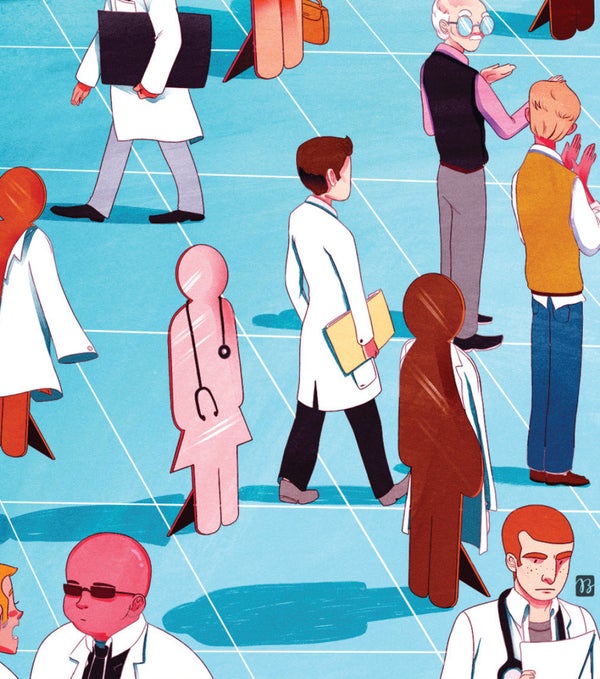
Tempers are running hot in science (as they are in the U.S. at large) as the field embarks on a long-overdue conversation about its treatment of women and people of color. In June 2020, for example, thousands of researchers and academics across the globe—as well as the preeminent journals Science and Nature—stopped work for a day to protest racism in their ranks. The American Physical Society endorsed the effort to “shut down STEM,” declaring its commitment to “eradicating systemic racism and discrimination” in science.
Physics exemplifies the problem. Black people make up about 14 percent of the college-age population in the U.S., commensurate with their numbers in the overall population, but in physics they receive 3 to 4 percent of undergraduate degrees and less than 3 percent of Ph.D.s, and as of 2012 they composed only 2 percent of faculty. No doubt there are many reasons for this underrepresentation, but one troubling factor is the refusal of some scientists to acknowledge that a problem could even exist. Science, they argue, is inherently rational and self-correcting.
Would that were true. The history of science is rife with well-documented cases of misogyny, prejudice and bias. For centuries biologists promoted false theories of female inferiority, and scientific institutions typically barred women’s participation. Historian of science and MacArthur fellow Margaret Rossiter has documented how, in the mid-19th century, female scientists created their own scientific societies to compensate for their male colleagues’ refusal to acknowledge their work. Sharon Bertsch McGrayne filled an entire volume with the stories of women who should have been awarded the Nobel Prize for work that they did in collaboration with male colleagues—or, worse, that they had stolen by them. (Rosalind Franklin is a well-documented example of the latter: her photographs of the crystal structure of DNA were shared without her permission by one of the men who then won the Nobel Prize for elucidating the double-helix structure.) Racial bias has been at least as pernicious as gender bias; it was scientists, after all, who codified the concept of race as a biological category that was not simply descriptive but also hierarchical.
On supporting science journalism
If you're enjoying this article, consider supporting our award-winning journalism by subscribing. By purchasing a subscription you are helping to ensure the future of impactful stories about the discoveries and ideas shaping our world today.
Good scientists are open to competing ideas; they attend to challenging data, and they listen to opposing views. But scientists are also humans, and cognitive science shows that humans are prone to bias, misperception, motivated reasoning and other intellectual pitfalls. Because reasoning is slow and difficult, we rely on heuristics—intellectual shortcuts that often work but sometimes fail spectacularly. (Believing that men are, in general, better than women in math is one tiring example.) It is not credible to claim that scientists are somehow immune to the biases that afflict everyone else.
Fortunately, the objectivity of scientific knowledge does not depend on the objectivity of individual scientists. Rather it depends on strategies for identifying, acknowledging and correcting bias and error. As I point out in my 2019 book, Why Trust Science, scientific knowledge begins as claims advanced by individual scientists, teams or laboratories that are then closely scrutinized by others, who may bring forward additional proof to sustain them—or to modify or reject them. What emerges as a scientific fact or established theory is rarely if ever the same as the starting claim; it has been adjusted in light of evidence and argumentation. Science is a collective effort, and it works best when scientific communities are diverse. The reason is simple: heterogeneous communities are more likely than homogeneous ones to be able to identify blind spots and correct them. Science does not correct itself; scientists correct one another through critical interrogation. And that means being willing to interrogate not just claims about the external world but claims about our own practices and processes as well.
Science has an admirable record of producing reliable knowledge about the natural and social world, but not when it comes to acknowledging its own weaknesses. And we cannot correct those weaknesses if we insist the system will magically correct itself. It is not ideological to acknowledge and confront bias in science; it is ideological to insist science cannot be biased despite empirical validation to the contrary. Given that our failings of inclusion have been known for a long time, it is high time we finally fix them.