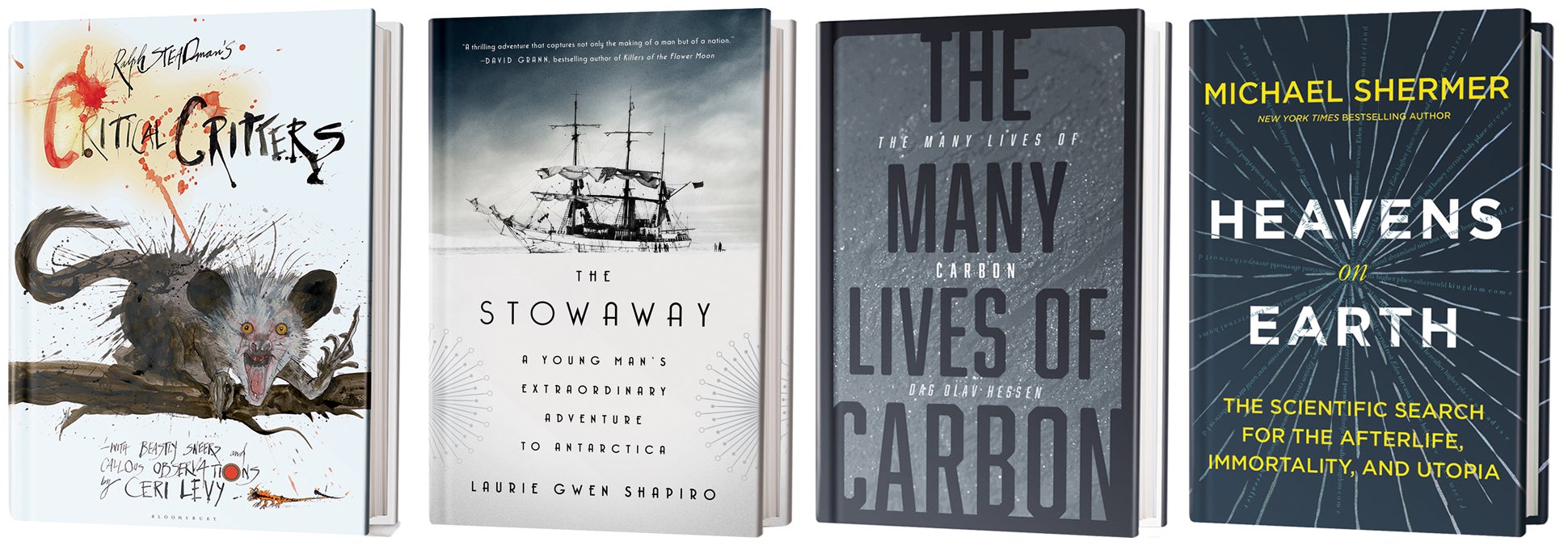
Critical Critters
by Ralph Steadman and Ceri Levy.
Bloomsbury Natural History, 2017 ($50)
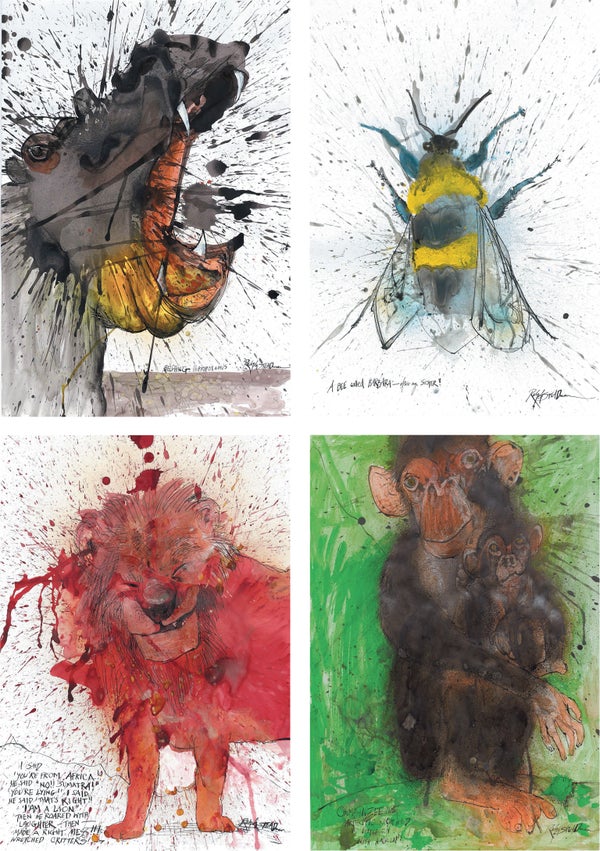
After collaborating on two books showcasing extinct and endangered birds, legendary cartoonist Steadman and filmmaker Levy have paired up again to create this eccentric, wildly imaginative collection of illustrations of other critically endangered animals. Steadman's drawings are nonconformist, splotched with color and a delightful overlay of finger-painting-like splashes and precise ink drawings. Levy's descriptions detail each creature's environment and the threats to its survival. The depictions of insects—the little mother moth, the Greek red damsel, the monarch butterfly—are particularly lavish, and an eerie bleakness is infused in the portraits of the snow leopard and giant panda. Humorous correspondences between the two authors accompany the drawings, adding some lightheartedness to heavy subject matter.
The Stowaway: A Young Man’s Extraordinary Adventure to Antarctica
by Laurie Gwen Shapiro.
Simon & Schuster, 2018 ($26)
On supporting science journalism
If you're enjoying this article, consider supporting our award-winning journalism by subscribing. By purchasing a subscription you are helping to ensure the future of impactful stories about the discoveries and ideas shaping our world today.
Eager to escape the family upholstery business, 17-year-old Billy Gawronski snuck onboard the ship City of New York in 1928. He was determined to stow away on a daring expedition—the first American journey to Antarctica in the 20th century. Journalist Shapiro tells his story alongside the ship's commander, Richard Evelyn Byrd, and his crew. Discovered after several attempts and finally allowed to remain onboard, Gawronski takes on the role of messboy, penguin catcher and crowd favorite for the New York newspapers. The journey achieved many scientific successes: the geologic mapping of certain regions of Antarctica, photographic documentation of the mysterious land and the testing of long-distance radio signals. After they reached the icy continent, the explorers unloaded a three-engine Ford transport plane, on which they would become the first ever to fly over the South Pole. —Yasemin Saplakoglu
The Many Lives of Carbon
by Dag Olav Hessen.
Reaktion Books, 2018 ($29)
One of the most familiar elements of the periodic table, carbon now plays diverging roles on our planet. It is essential to all living things on the earth, yet in the form of carbon dioxide, it threatens their existence by warming our world to dangerous levels. “Carbon, life's element, has become our greatest threat,” writes Hessen, a biologist who studies the life cycle of carbon. He profiles the many vital contributions the element makes to human life and gives a fascinating explanation of how its structure renders it so useful in diverse materials and situations, from fire to photosynthesis.
Hessen also describes how carbon's chemistry turns it into such a menace to our climate by trapping heat via the greenhouse effect, and he eloquently highlights the need to use our carbon wisely, lest we irreversibly disrupt the delicate balance it has enjoyed on our globe for the past 4.5 billion years. —Clara Moskowitz
Heavens on Earth: The Scientific Search for the Afterlife, Immortality, and Utopia
by Michael Shermer.
Henry Holt, 2018 ($30)
Author Shermer (who is a columnist for Scientific American and a member of its advisory board) uses a scientific lens to examine how the cultures and religions of the world view human mortality and what comes after death. He shines scientific skepticism on near-death experiences (most likely hallucinations, in his estimation), the afterlife (no evidence found) and efforts to extend human lives through technological endeavors—such as uploading minds into computers (technologically unfeasible). He recognizes that finding meaning in a meaningless universe can be troublesome, especially without the postlife end goal that many religions and philosophies promise. As Shermer writes, “there are scientific answers to such deep questions, if we reflect upon them with reason, honesty, and courage.”