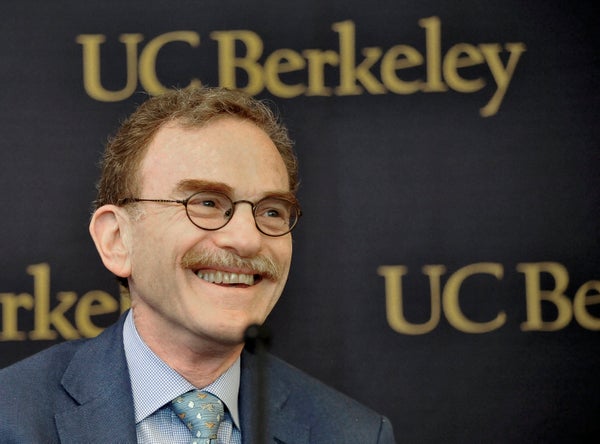
Randy Schekman is a cell biologist at the University of California, Berkeley. He shared the 2013 Nobel Prize in Physiology or Medicine for discoveries revealing the mechanisms that regulate vesicle transport within cells, advancing understanding of how cells organize and move proteins.
[This interview was edited for length and clarity.]
How would you describe the current state of American science?
On supporting science journalism
If you're enjoying this article, consider supporting our award-winning journalism by subscribing. By purchasing a subscription you are helping to ensure the future of impactful stories about the discoveries and ideas shaping our world today.
American science and scientific research remain the envy of the world. Although the role and impact of basic scientific research have not always been appreciated by the public, both political parties have traditionally been very supportive of research in universities and research institutes. We now face a politically motivated decay of public support of science and the scientific method. Policies of the current federal administration and in certain states have imperiled our global leadership and prospects for the next generations of aspiring scholars of science with the potential for significant damage to our nation’s public health and biomedical and industrial leadership.
What needs to change in American science?
The political leadership of both of our major parties must step up to sustain the research enterprise in our public and private universities. The leadership of our scientific and university institutions must speak out more forcefully to the nation in defense of science. Despite the current crisis, our institutions of higher education remain strong and will survive, if even in a diminished capacity for the years ahead. To remain a global leader, we must invest in our science infrastructure.
What gives you optimism right now?
The American spirit of independence, ingenuity and ambition will restore our reputation as a beacon of leadership around the world. Despite proposed substantial cuts in the federal science budgets, a massive lobbying effort on the part of health care groups and scientists worked effectively to convince Congress to maintain status quo budgets for science in the current year. The potential for breakthrough scientific discoveries gives me hope.
Philanthropy has an equally important role in sustaining scientific excellence in the U.S. and around the world. I chair the advisory board of one such effort, the Aligning Science Across Parkinson’s (ASAP) initiative, a basic research program supported by the Sergey Brin [Family Foundation] and Michael J. Fox [Foundation for Parkinson’s Research]. Internationally collaborative and open-science efforts such as this are putting us on a path toward a meaningful treatment to halt the progression of Parkinson’s disease. I am confident that will happen in the next five years.
What’s your best advice for an early-career scientist?
Remain focused on the future and resilient in the face of the current cutbacks.
This shall pass, and American preeminence in science will be restored.
How has your field changed in the past few years?
Artificial intelligence and other computational tools have greatly improved the precision with which we are able to investigate biological processes. For instance, ASAP and the Allen Institute have a joint project that enables researchers to visualize and explore data from millions of human brain cells. This technology advancement helps them better understand the biological connections between neurodegenerative diseases, such as Parkinson’s and Alzheimer’s, as never before.