
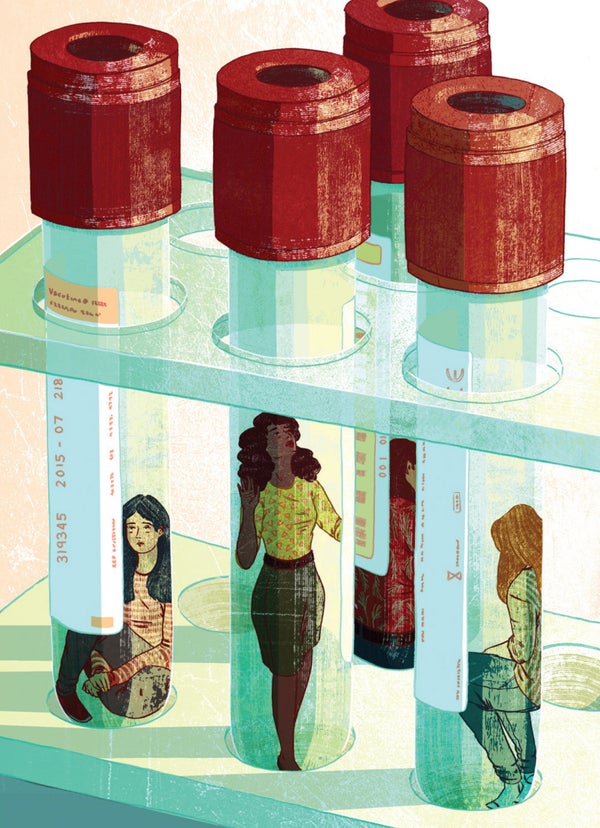
Across the country a crucial trove of crime-solving data is sitting unused in the form of untested rape kits. These cardboard boxes contain envelopes filled with hairs, skin cells, semen, clothing and other forensic evidence collected from survivors after they report a sexual assault. If the DNA on these items matches DNA in a criminal database, it can lead to an arrest. It is practically criminal, then, to put women through the emotionally and physically difficult, hours-long collection process and then never analyze the kits. Yet more than 100,000 rape kits in the U.S. are collecting dust on shelves in laboratories, hospitals and police stations because states lack the money—or the will—to process them.
We now know that if the kits are analyzed, more criminals are caught and more victims get justice. The Manhattan District Attorney in New York City handed out grants for rape kit testing to 20 states between 2015 and 2018, for example, and 186 arrests were made and 64 convictions won—many of them against serial rapists whose DNA showed up in multiple kits. An ongoing effort to test an archive of old kits in Cuyahoga County, Ohio, has led to more than 400 convictions, mostly in cold cases. “It's dangerous to leave these people on the streets,” says Ilse Knecht, director of policy and advocacy for the Joyful Heart Foundation, a nonprofit that supports sexual-assault survivors. “Research shows that the longer they are on the streets the more crimes they commit because they're [often] serial offenders.”
More jurisdictions must join these efforts. It's not just money that's needed to fix the problem. Many states act as if the kits are unimportant and have no system to track and process them—they don't even have exact counts of how many are sitting unused.
On supporting science journalism
If you're enjoying this article, consider supporting our award-winning journalism by subscribing. By purchasing a subscription you are helping to ensure the future of impactful stories about the discoveries and ideas shaping our world today.
Along with Washington, D.C., 32 states have now passed bills requiring newly collected kits to be tested, and 25 states require some kind of tracking. Yet the laws are a patchwork—they don't cover all that needs to be done, and they leave many states without legislation addressing the backlog. On the federal level, in December 2019, President Donald Trump signed the Debbie Smith Act, reauthorizing a 2004 bill to make $151 million a year available to test criminal forensic evidence. But the money is for all kinds of DNA evidence, not just rape kits, and its grants help only with untested kits that have already been sent to labs—not with the larger backlog of kits still at police or hospital warehouses.
Because these are only partial solutions, the overall situation is getting worse. A 2019 report from the Government Accountability Office found that between 2011 and 2017 the number of backlogged requests for DNA analysis of crime scenes—mostly made up of rape kits—grew by 85 percent. “What's happening is that the demand [for testing] has increased so much there is in some places a new backlog,” Knecht says. Police are using kits more often, in part because there is an increased awareness of how useful forensic evidence is in securing convictions, even as states are still trying to process old kits. “In general, the whole system needs to be ramped up for more capacity,” she adds.
Few states are fully tackling all six of the strategies suggested by Joyful Heart to adequately address the problem: (1) require an annual statewide inventory of untested kits, (2) make testing all untested kits mandatory, (3) make testing of all new kits collected mandatory, (4) establish a statewide tracking system, (5) require survivors to be informed of the status of their kit and (6) provide the necessary funding for each of these initiatives.
Doing all these things is the best route to justice that survivors have. We must believe what survivors tell us and treat the crime of rape seriously. We need to honor their courage in reporting crimes and giving evidence by actually using that evidence to catch rapists.

Credit: Amanda Montañez; Source: Joyful Heart Foundation, www.endthebacklog.org