
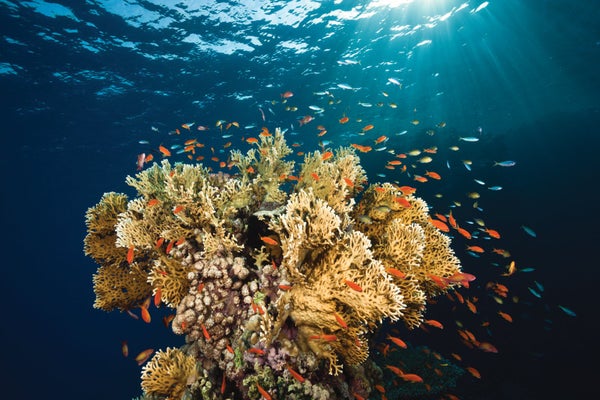
As rising ocean temperatures threaten coral reefs worldwide, identifying the most heat-resilient coral colonies is crucial for conservation efforts. Typical methods require flying samples to distant laboratories and subjecting them to high temperatures for weeks. Now a new heat-stress test brings the lab to the reef, yielding results within a single day.
The Coral Bleaching Automated Stress System (CBASS), made from materials commonly available at hardware stores, consists of four 10-liter tanks that can be set up on the same boats researchers use to reach the reefs. “You just jump into the water, get the corals, and put them into the tanks and get everything started,” says Carol Buitrago López, a graduate student at King Abdullah University of Science and Technology (KAUST) in Saudi Arabia. She and her colleagues described CBASS in August in Global Change Biology.
The team placed finger-sized coral samples from two Red Sea sites into CBASS tanks at a baseline temperature of 30 degrees Celsius (86 degrees Fahrenheit). Over three hours the system increased each tank's temperature to a different value—39 degrees C was the maximum—then held there it for another three hours, dropping it back to 30 over the next hour. Finally, the scientists gave the corals 11 more hours to recover. They used a flashlightlike device to measure how efficiently the microalgae in the corals used light when photosynthesizing (a well-established indicator of a plant's stress level). This short-term measurement aligned with the results from a traditional long-term heat-stress experiment, showing the method's potential to rapidly identify resilient corals.
On supporting science journalism
If you're enjoying this article, consider supporting our award-winning journalism by subscribing. By purchasing a subscription you are helping to ensure the future of impactful stories about the discoveries and ideas shaping our world today.
“I would love to adopt [CBASS] in my research,” says Mikhail Matz, who researches coral genetics at the University of Texas at Austin and was not involved with the study. “The whole simplicity of this approach is very appealing.” Although coral reefs are too vast to test in their entirety, researchers can harness CBASS's speed to measure targeted coral samples at a scale not previously possible. In a follow-up experiment, “we measured 500 corals in two weeks,” says Christian Voolstra, a researcher at KAUST and the University of Konstanz in Germany and lead author of the new paper. “Traditionally this would be your lifetime as a professor.”
Whether the corals that perform best in CBASS experiments will indeed withstand climate change remains an open question, Matz cautions. Still, he says, CBASS's standardized procedure will let researchers directly compare the heat tolerances of coral colonies around the world, a key step in restoration efforts. Conservation scientists commonly grow coral fragments in a nursery and then transfer them to degraded reef systems. So far such “outplanting” projects have met with limited success. But outplanting the most heat-tolerant corals, Voolstra says, could help buy time until climate change can be brought under control.