
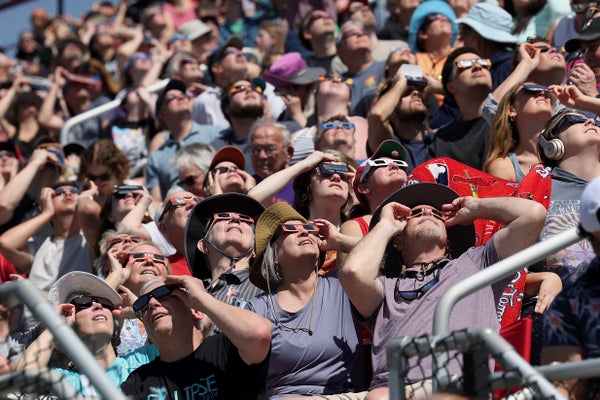
Are you wondering what to do with your eclipse glasses now that the April 8 total solar eclipse has come and gone?
The nonprofit group Astronomers Without Borders (AWB) has partnered with libraries, schools, museums, businesses and other organizations across the U.S. and Canada to collect and recycle gently used eclipse-viewing glasses. The glasses will be sent to underserved communities and schools around the world to use during future solar eclipses, according to a statement from the organization.
"This one-of-a-kind program helps to bring eclipse glasses to people who may not otherwise have a safe way to view the eclipse directly," AWB officials said in the statement. "AWB is committed to continue sending glasses to those who need them for outreach and educational programs around the world."
On supporting science journalism
If you're enjoying this article, consider supporting our award-winning journalism by subscribing. By purchasing a subscription you are helping to ensure the future of impactful stories about the discoveries and ideas shaping our world today.
On Monday (April 8), a total solar eclipse passed over Mexico, 15 U.S. states and Canada. A solar eclipse occurs when the moon passes between Earth and the sun, casting a shadow on our planet's surface. For those in the path of totality, the moon appears almost exactly the same size as the sun, so it blocks the entire solar disk for a few minutes. However, solar eclipse glasses are needed to safely view the sun during the partial phases of an eclipse.
Millions of solar eclipse glasses were used by viewers across North America, and now AWB wants to prevent them from unnecessarily ending up in landfills. Every pair of glasses donated will be inspected by trained volunteers to make sure they meet safety certifications and are not damaged or counterfeit, according to the statement.
One of AWB’s donation partners is Warby Parker, a prescription glasses retailer, which will use over 240 retail locations across the U.S. to collect used eclipse glasses through April 30. Other donation locations include Vessel Refillery FW in Indiana, Keep Toledo/Lucas County Beautiful and Twinsburg Public Library in Ohio, and Montshire Museum of Science and Chittenden Solid Waste District in Vermont. The latest list of AWB collection partners can be found online.
AWB has also partnered with the Green Bank Observatory in West Virginia to help with processing and storing collected glasses before they are sent to underserved communities around the world, according to the statement.
"This unique resource-sharing project is the second recycling campaign AWB is conducting, having had great success distributing hundreds of thousands of eclipse glasses collected from the 2017 American solar eclipse," AWB officials said in the statement. "Recycled and vetted solar glasses were sent to schools that were in the path of solar eclipses in South America, Africa and Asia over the past seven years."
AWB also aims to make eclipses more accessible with its "One Eclipse" app. The app features an interactive eclipse map for users to pinpoint the perfect viewing spot, along with a countdown timer for when the moon's shadow will pass overhead. The app also has an eclipse simulator that lets users see what the eclipse will look like from any location on Earth, from start to finish. One Eclipse can be downloaded on both Apple and Android devices.
Editor's Note: If you snapped an amazing solar eclipse photo and would like to share it with Space.com's readers, send your photo(s), comments, and your name and location to spacephotos@space.com.
Copyright 2024 Space.com, a Future company. All rights reserved. This material may not be published, broadcast, rewritten or redistributed.