
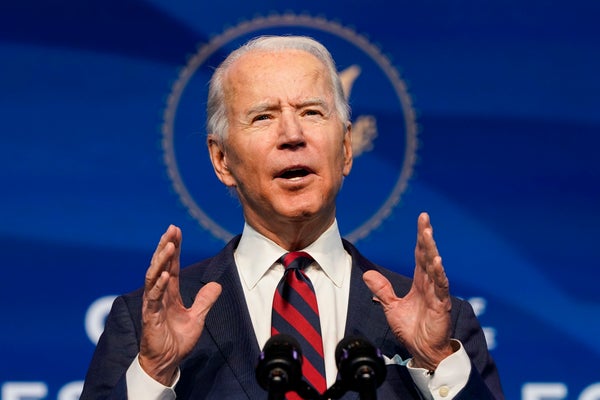
Ten Republican attorneys general yesterday asked a federal court to swiftly block President Biden from raising a key metric for greenhouse gases.
In a motion for preliminary injunction, the red states urged the U.S. District Court for the Western District of Louisiana to prevent Biden’s interim social cost of carbon from taking effect across the federal government.
"Plaintiff States are substantially likely to prevail on the merits of their claims and preliminary injunctive relief is necessary to avoid imminent and substantial injuries to their sovereign, quasi-sovereign and proprietary interests," the motion says.
On supporting science journalism
If you're enjoying this article, consider supporting our award-winning journalism by subscribing. By purchasing a subscription you are helping to ensure the future of impactful stories about the discoveries and ideas shaping our world today.
The 10 states sued in April over Biden’s plans to increase the social cost of carbon, a key metric that assigns a dollar value to the harm caused by emitting 1 ton of greenhouse gases (Climatewire, April 23).
The metric is used in cost-benefit analyses underpinning major federal actions, such as EPA’s emissions rules for coal-fired power plants.
Biden signed a Jan. 20 executive order that established an interagency working group tasked with recommending an interim social cost of carbon within 30 days—and a final social cost of carbon by January 2022.
The working group in March endorsed raising the social cost of carbon to $51 per ton. Under former President Trump, the figure had fallen to as little as $1 per ton (Climatewire, March 1).
The lawsuit alleges that Biden’s moves violated federal rulemaking requirements and the intent of Congress. Led by Louisiana Attorney General Jeff Landry (R), the suit was also brought by the attorneys general of Alabama, Florida, Georgia, Kentucky, Mississippi, South Dakota, Texas, West Virginia and Wyoming.
A coalition of 12 other attorneys general launched a separate legal challenge to Biden’s interim social cost of carbon in March (E&E News PM, March 8).
That complaint, which was spearheaded by Missouri Attorney General Eric Schmitt (R), asserts that Biden lacked the authority to raise the climate metric under the Constitution, which gives that power to Congress.
The Missouri-led coalition has also asked the U.S. District Court for the Eastern District of Missouri to prohibit Biden’s interim social cost of carbon from being used in agency rulemakings.
Judge Audrey Fleissig, who was appointed during the Obama administration, has scheduled an Aug. 20 hearing on its request.
The Department of Justice doesn’t comment on pending litigation.
Reprinted from E&E News with permission from POLITICO, LLC. Copyright 2021. E&E News provides essential news for energy and environment professionals.