New Issue: Orbital Catastrophe Ahead? Read Now

Redefining the Kilogram

Officials will vote to overhaul the SI system of measurements, basing units such as the kilogram not on physical objects but on fundamental constants

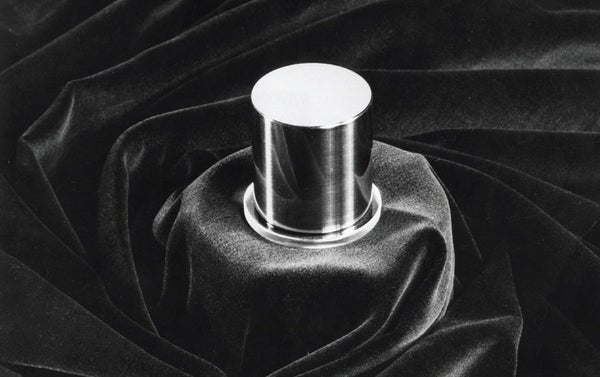
Kilogram No. 20, in the U.S., is one of several “working standards.”

Science Source

Join Our Community of Science Lovers!

The kilogram is shrinking.

The official object that defines the mass of a kilogram is a tiny, 139-year-old cylinder of platinum and iridium that resides in a triple-locked vault near Paris. Because it is so important, scientists almost never take it out; instead they use copies called working standards. But the last time they did inspect the real kilogram, they found it is roughly five parts in 100 million heavier than all the working standards, which have been leaving behind a few atoms of metal every time they are put on scales. This is one of the reasons the kilogram may soon be redefined not by a physical object but through calculations based on fundamental constants.

“This [shrinking] is the kind of thing that happens when you have an object that needs to be conserved in order to have a standard,” says Peter Mohr, a physicist at the National Institute of Standards and Technology (NIST), who serves on the committee that oversees the International System of Units (SI). “Fundamental constants, on the other hand, are not going to change over time.”


On supporting science journalism

If you're enjoying this article, consider supporting our award-winning journalism by subscribing. By purchasing a subscription you are helping to ensure the future of impactful stories about the discoveries and ideas shaping our world today.


The redefinition of the kilogram will be part of a planned larger overhaul to make SI units fully dependent on constants of nature. Representatives from 57 countries will vote on the proposed change this month at a conference in Versailles, France, and the new rules are expected to pass. Along with the kilogram, the ampere (the unit of electric current), kelvin (temperature) and mole (amount of a substance) will get new definitions. The four will be based on Planck's constant, the elementary charge, the Boltzmann constant and the Avogadro constant, respectively. All these constants are determined by laboratory measurements, which have some inherent uncertainty. But if the vote is successful, countries using SI will agree on a fixed value for each constant based on the best data available and use them to derive the units.

What will happen to the old kilogram artifacts after the redefinition? Rather than packing them off to museums, scientists plan to keep studying how they fare over time. “There is so much measurement history on these,” says physicist Stephan Schlamminger of NIST. “It would be irresponsible to not continue to measure them.”

Clara Moskowitz is chief of reporters at Scientific American, where she covers astronomy, space, physics and mathematics. She has been at Scientific American for more than a decade; previously she worked at Space.com. Moskowitz has reported live from rocket launches, space shuttle liftoffs and landings, suborbital spaceflight training, mountaintop observatories, and more. She has a bachelor’s degree in astronomy and physics from Wesleyan University and a graduate degree in science communication from the University of California, Santa Cruz.

More by Clara Moskowitz
Scientific American Magazine Vol 319 Issue 5This article was published with the title “Measure for Measure” in Scientific American Magazine Vol. 319 No. 5 (), p. 19
doi:10.1038/scientificamerican1118-19

Subscribe to Support Independent Journalism

Great science journalism requires human expertise, time, effort and creativity. And it costs money. That’s why I and the journalists here at Scientific American hope you’ll join our community.

When you subscribe, you are supporting staff and freelance journalists who are passionate about telling science stories that are true, important and compelling. Our editors and reporters are often experts in their fields, which means they understand the nuances of big discoveries and can untangle the breakthroughs from the hype. With a subscription, you are also supporting rigorous fact-checking to ensure the words we publish are precise and accurate. And you’re supporting original illustrations, graphics and photos that bring you closer to an advanced laboratory, an ice sheet in Antarctica or a space mission in orbit. You’re helping us craft other types of high-quality journalism as well: Our newsletters are carefully written, edited and curated by staffers you have or will come to know and love. Our Science Quickly podcast is based on original reporting, collaboration with editors and scientists and exacting production.

Subscriptions keep this engine running so we can continue to deliver thoughtful, rigorous and independent science journalism to you. In an era of viral misinformation, this work is crucial. If you value what we do, I hope you’ll consider joining us as a subscriber

Thank you,

Jeanna Bryner, Editor in Chief, Scientific American

Subscribe