
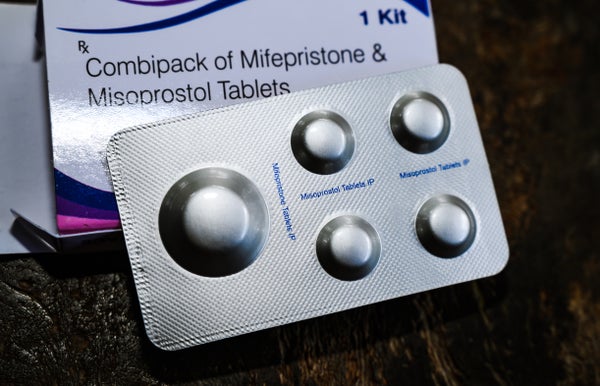
The Trump administration is officially conducting an investigation into the safety of the abortion pill mifepristone, the Wall Street Journal reports. Health experts worry that the process may be politically motivated rather than based on science.
Mifepristone has been approved by the U.S. Food and Drug Administration since 2000 and is widely considered by health professionals to be safe and effective. Last year Secretary of Health and Human Services Robert F. Kennedy, Jr., announced plans to review mifepristone’s safety, citing concerns over a pandemic-era policy that has allowed the medication to be prescribed via telehealth. After months with no apparent movement on the review, the Trump administration faced criticism from antiabortion advocates, who urged the administration to pick up the pace.
Now the FDA appears to be accelerating that process. “The evidence has never been in question,” says Ushma Upadhyay, a professor in the department of obstetrics, gynecology and reproductive sciences at the University of California, San Francisco, who has studied the safety of online abortion services. “Mifepristone, when delivered via telehealth, is as safe and effective as in-person care. It is well supported by research and can be a lifeline to many who need this care but can’t get it at a clinic or office.”
On supporting science journalism
If you're enjoying this article, consider supporting our award-winning journalism by subscribing. By purchasing a subscription you are helping to ensure the future of impactful stories about the discoveries and ideas shaping our world today.
“If done with integrity, the FDA’s review should confirm its safety and preserve people’s access to this essential care,” she adds.
Other experts point to the Trump administration’s track record of skipping ahead of the science on other issues, such as autism. “Based on what we have seen from this administration to date, there is every reason to fear that this study will be a cherry-picking, data-contorting exercise designed to support a predetermined conclusion of lack of safety,” said Peter Lurie, former associate commissioner for public health strategy and analysis at the FDA, to Scientific American last October, shortly after Kennedy’s announcement.
The Trump administration says the investigation has been ongoing. “The FDA has been actively working on a science-based safety review of the mifepristone REMS [risk evaluation and mitigation strategy] for months, as the agency has stated publicly and in court filings,” an FDA spokesperson says. “Any reporting suggesting otherwise, including that a study is just being started, is either false or based on a fundamental misunderstanding of how complex scientific safety studies work.”
Mifepristone is currently available by mail, but legal challenges are continuing. Last month the Supreme Court extended a stay on a lower court ruling that would have made it illegal nationwide to mail the drug.
If access to mifepristone by mail is eventually overturned, doctors could respond by switching to prescribing the drug misoprostol, another medication that can induce an abortion, on its own. But misoprostol may come with added side effects, leading to more patients seeking care for possible complications and prescribers encountering an extra layer of complexity.
The review will take about six months, sources told the Wall Street Journal, and the results will likely be released after the midterm elections in November.
Editor’s Note (6/5/26): This is a breaking news story and will be updated.