
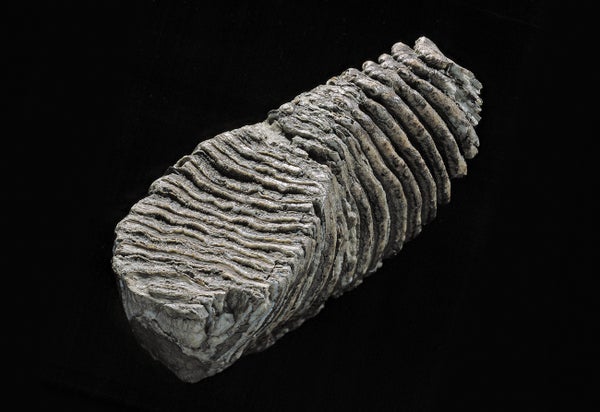
Woolly: The True Story of the Quest to Revive One of History's Most Iconic Extinct Creatures
by Ben Mezrich.
Atria, 2017 ($26)
What if extinction weren't permanent after all? Several years ago pioneering Harvard University geneticist George M. Church (who serves on Scientific American's advisory board) and his colleagues launched a project to resurrect the famous woolly mammoth by splicing its preserved genetic code with that of an elephant. Animals like the mammoths, which adapted to live in steppe habitats, prevent tree growth and turn and stomp topsoil, exposing the earth underneath to the cold winds of the region, thereby lowering the ground temperature and preserving the underlying permafrost (and the potent greenhouse gas methane locked within it). Thus, a reestablished population of woolly mammoths might be a heavyweight stopgap to methane-driven climate change. As much a profile of Church and his rise to renowned scientist as it is a tour of the latest research on climate change, species extinction and conservation biology, author Mezrich's telling is riveting and almost too like fiction to be believed.
Through the Shadowlands: A Science Writer's Odyssey into an Illness Science Doesn't Understand
by Julie Rehmeyer.
Rodale, 2017 ($25.99)
On supporting science journalism
If you're enjoying this article, consider supporting our award-winning journalism by subscribing. By purchasing a subscription you are helping to ensure the future of impactful stories about the discoveries and ideas shaping our world today.
At the height of her illness, Rehmeyer would wake up unable to move her arms or legs or sometimes even to speak. The many doctors she saw offered no treatment but diagnosed her with chronic fatigue syndrome (CFS)—a poorly understood and hardly studied affliction. Desperate, the science writer reluctantly turned to other CFS patients on the Internet who touted a theory she initially dismissed as crazy—that toxic mold was making her sick. Their recommendation: trash most of her belongings and spend two weeks in the desert to escape the mold. She tried it and was shocked to find herself on a path to rapid recovery. In this engrossing memoir, Rehmeyer describes her frustration at a medical system that has failed CFS patients and her conflicting emotions around the improbable but effective remedy she found. —Clara Moskowitz
Quakeland: On the Road to America's Next Devastating Earthquake
by Kathryn Miles.
Dutton, 2017 ($28)
In 1959 an earthquake near Yellowstone National Park killed 28 people, most of whom were camping along Hebgen Lake when a collapsing canyon wall buried the area in a landslide of 80 million tons of boulders and trees. The force of the falling rock created a hurricane-strength wind that overturned cars and ripped survivors from their campsites. Science journalist Miles uses the Hebgen Lake earthquake as an example of the damage these events can wreak. She spent a year exploring the U.S.—sometimes climbing far below the earth's surface—with scientists who study seismic activity. She discusses the mechanics of quakes, the increase in human-induced tremors, the ways cities are safeguarding infrastructures (or not) against damage, and advances in technology that make these fleeting but powerful phenomena easier to predict. —Andrea Marks
Improbable Destinies: Fate, Chance, and the Future of Evolution
by Jonathan B. Losos.
Riverhead, 2017 ($28)
When evolutionary biologists observe that some traits in nature evolve independently over and over again (hydrodynamic body shape in large ocean animals like dolphins and sharks or spiny protrusions in unrelated porcupinelike mammals from Africa or North America), they wonder whether such traits are inevitable. Is evolution predictable, always yielding the same traits, or is it contingent on infinite variables, delivering infinite outcomes? Evolutionary biologist Losos profiles the latest probes into this question, including his own work in the Bahamas monitoring lizard body measurements in various habitats. He concludes that evolution is somewhat predictable, though only to a certain extent. Plenty of random chance led the planet's evolution down one path and not another. Have the earth's species been lucky in this regard? “Yes,” he answers. “Destined? No.”
