

The following essay is reprinted with permission from The Conversation, an online publication covering the latest research.
Although most species of plants on Earth have flowers, the evolutionary origin of flowers themselves are shrouded in mystery. Flowers are the sexual organs of more than 360,000 species of plants alive today, all derived from a single common ancestor in the distant past. This ancestral plant, alive sometime between 250m and 140m years ago, produced the first flowers at a time when the planet was warmer, and richer in oxygen and greenhouse gases than today. A time when dinosaurs roamed primeval landscapes.
On supporting science journalism
If you're enjoying this article, consider supporting our award-winning journalism by subscribing. By purchasing a subscription you are helping to ensure the future of impactful stories about the discoveries and ideas shaping our world today.
But despite the fact dinosaurs went extinct 65m years ago we have a better idea of what an Iguanodon looked like than of how the ancestral flower was built.
This is partly because these first flowers left no traces. Flowers are fragile structures that only in the luckiest of circumstances can be transformed into fossils. And, as no fossil has been found dating back 140m or more years, scientists have only had a limited sense of what the ultimate ancestor would have looked like. Until now.
A major new study by an international team of botanists has achieved the best reconstruction to date of this ancestral flower. The research, published in Nature Communications, relies not so much on fossils as on studying the characteristics of 800 of its living descendant species.
By comparing the similarities and differences among related flowering plants, it is possible to infer the characteristics of their recent ancestors. For example, because all orchid species have flowers in which one half is the mirror image of the other (bilateral symmetry), we can suppose that their ancestor must have had bilateral flowers. By comparing those recent ancestors to each other it is then possible to go a step further back in time, and so on, until eventually we reach the base of the flowering plants’ family tree.
So what did it look like?
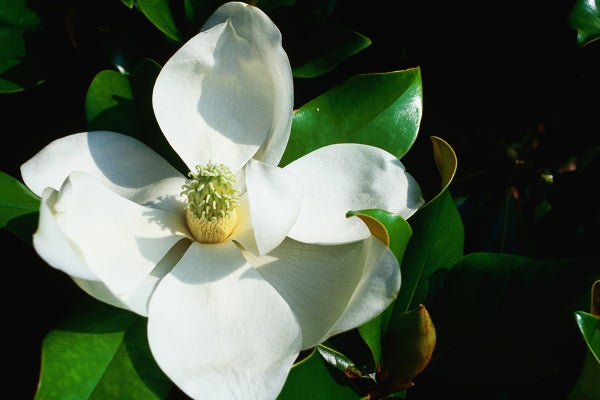
In some respects, the original flower resembles a modern magnolia: it has multiple, undifferentiated “petals” (technically tepals), arranged in concentric rings. At its centre there are multiple rows of sexual organs including pollen-producing stamens and ovule-bearing ovaries. It is hard to resist the temptation to imagine ancient pollinators crawling in this flower, collecting pollen grains while unknowingly helping the plant to produce seeds.
A controversial sex life
The new study helps to settle the controversy about whether early flowers had separate sexes, or whether both male and female reproductive organs were combined in the same flower. Previous evidence pointed to different answers. On the one hand, one of the earliest diverging lineages of flowering plants, represented nowadays only by a rare shrub from the Pacific island of New Caledonia called Amborella, has flowers that are either male or female. On the other, most modern species combine both sexes in the same flower.
The authors of the study settle the question and show that the ancestral flower was a hermaphrodite. This means that early flowering plants could reproduce both as a male and a female. Combined sexes can be advantageous when colonising new environments as a single individual can be its own mate, and indeed many plant species colonising remote oceanic islands tend to be hermaphrodite. Maybe the combination of sexes helped early flowering plants to outcompete their rivals.
The devil’s in the detail
Despite the apparent similarity with some modern flowers, their ultimate ancestor has a few surprises up its sleeve. For example, botanist have long thought that early flowers had floral parts arranged in a spiral around the centre of the flower as can be seen in modern species such as the star anise.

The new reconstruction, though, strongly suggests that early flowers had their organs arranged not in a spiral, but in series of concentric circles or “whorls”, as in most modern plants. The early flower had more numerous whorls, however, suggesting flowers have become simpler over time. Paradoxically, this simpler architecture may have given modern plants a more stable base upon which to evolve and achieve more complex tasks such as sophisticated interaction with certain insects as in orchids, or the production of “flower heads” made of dozens or hundreds of simpler flowers as in the sunflower family.
Although now we have a good idea of what one of the earliest flowers may have looked like, we still know little about how that flower came to be. The detailed steps leading to its evolution are unknown. Perhaps we will have to wait for the discovery of new fossil flowers spanning the gap around 250m-140m years ago, before we can understand the very origin of what is the most diverse sexual structure on the planet.
This article was originally published on The Conversation. Read the original article.