
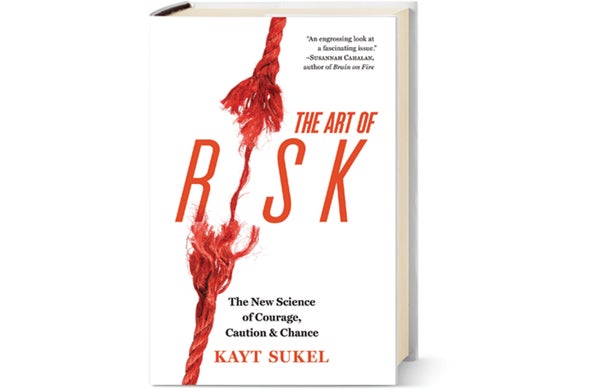
The Art of Risk
by Kayt Sukel
National Geographic Books, 2016 ($26; 288 pages)
Sukel used to do a lot of crazy stuff. She explored Africa and the Middle East with an infant strapped to her back when her first husband was deployed in Iraq. Then the science writer got divorced and settled in the suburbs with her son and a mortgage. Life became predictable. After a surprise marriage proposal from her boyfriend of only a few months, though, Sukel decided to reengage with her more daring self.
To do so, she realized she needed to understand what risk really is—research that gave rise to her new book. In it, she delves into the economics and neuroscience of risk and interviews people who make dicey decisions everyday to learn what holds people back or encourages them to take chances. Risk, Sukel discovers, is not just laying down $100 on a roulette table or jumping out of a plane; it pervades our daily life. Any decision that could end poorly involves risk.
On supporting science journalism
If you're enjoying this article, consider supporting our award-winning journalism by subscribing. By purchasing a subscription you are helping to ensure the future of impactful stories about the discoveries and ideas shaping our world today.
Indeed, Sukel explains that humans possess an internal risk calculator fueled by our intuition about the potential consequences of our choices. Research shows that this risk calculator balances input from emotional and memory centers of the brain with information from the prefrontal cortex, which regulates how we make decisions and inhibits impulsive behavior.
But our sense of risk is also deeply intertwined with our genetics. Scientists have found a few genes that seem to make for daredevils. College-aged men with one variant of the DRD4 gene, for example, gamble more brazenly in laboratory tests. These gene variants, Sukel says, may set someone's threshold for taking chances lower or higher. Our social environment also plays an important role. Friends’ behaviors can shift our ideas of what is unsafe. “If your peers are engaging in a particular behavior—whether it be smoking pot, drag racing or running off to an ashram in India—you won't perceive it as overwhelmingly risky,” Sukel writes. Teenagers are especially susceptible to this bias because they don't have as much life experience to fuel their intuition about potentially dangerous situations.
In fact, the most successful risk takers are effective planners. Sukel's interviews with a neurosurgeon, a base jumper and a special forces operator reveal just how key preparation is to success in perilous situations. Throughout the book, she guides us through the science of risk and the many factors that influence whether we accept or reject it. Perhaps most important, she helps to redefine risk by highlighting how integral it is to everyday human life. She suggests we can use our understanding of these gambles to maximize the positive consequences of our decisions, such as the possibility of a happy second marriage.
Sukel concludes: “It's time we accept that risk is part and parcel of every single decision we make, every single day—big or small, life-altering or seemingly inconsequential.”