
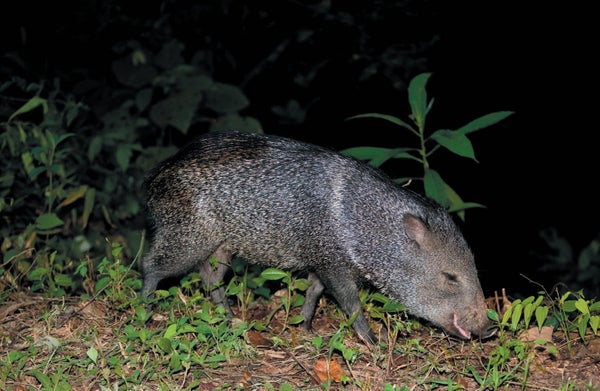
The white-lipped peccary, a piglike animal native to Central and South America, usually forages for fruit and other plants during the day and sleeps at night. But scientists in Brazil's Pantanal wetlands have found that when it gets unusually hot, these animals become more nocturnal. This behavioral flexibility could help peccaries—and potentially other species—adapt to climate change. “Maybe there's hope for species to be resilient, to an extent,” says Michaela Peterson, a doctoral candidate at Vanderbilt University and coauthor of a recent study published in Biotropica. The study found that during relatively balmy periods, when daily high temperatures were lower than 80 degrees Fahrenheit on average, white-lipped peccaries were most active in the afternoon. In slightly hotter weather they shifted their activity to the morning. But once average daily highs topped 94 degrees F, peccaries were most active after sunset.
Studies have found similar shifts in other species, including giant anteaters and cheetahs. But even though becoming more nocturnal seems like an obvious way to beat the heat, the potential impact of climate change on the timing of animal activity has not been widely studied, says Michiel Veldhuis, an ecologist at Leiden University in the Netherlands, who was not involved in the new research.
These studies looked at how shorter-term temperature fluctuations changed the animals' behavior, and it's not certain that any species will become permanently more nocturnal because of climate changes in the long term. Embracing the night life could come with significant trade-offs: Nocturnal predators such as pumas often hunt peccaries and anteaters, and Veldhuis says he would like to test whether predation kills more peccaries during the hottest months of the year. Animals used to the daylight also might have trouble spotting their own food if they make the switch, says postdoctoral ecologist Kwasi Wrensford of the University of British Columbia, who was not involved in the new research.
On supporting science journalism
If you're enjoying this article, consider supporting our award-winning journalism by subscribing. By purchasing a subscription you are helping to ensure the future of impactful stories about the discoveries and ideas shaping our world today.
Plus, animals that are usually active during the day might try to avoid nocturnal activity when possible. Peterson says the fact that the peccaries shifted their activity to the morning first—when it's cooler, but there is more light than at night—may indicate that the animals still prefer to be active during the day and become creatures of the night only when temperatures turn truly sweltering.