
From mining projects to oil and gas operations, human activity has set off earthquakes around the world and in many geological settings. Research now highlights how big these quakes can get — and how little scientists agree on which ones are caused by people.
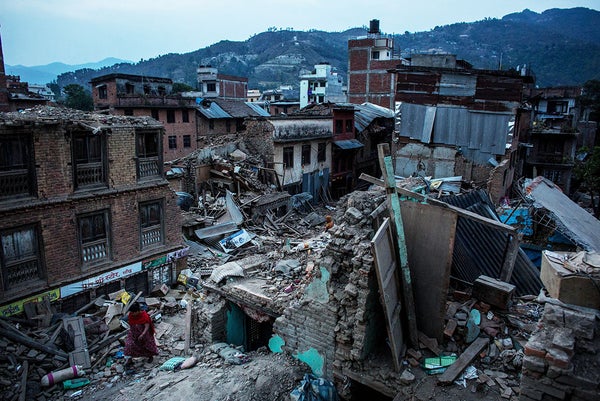
The Human-Induced Earthquake Database, or HiQuake, contains 728 examples of earthquakes (or sequences of earthquakes) that may have been set off by humans over the past 149 years. Most of them were small, between magnitudes 3 and 4. But the list also includes several large, destructive earthquakes, such as the magnitude-7.8 quake in Nepal in April 2015, which one paper linked to groundwater pumping1.
Miles Wilson, a hydrogeologist at Durham University, UK, and his colleagues describe the database in a paper set to be published on October 4 in Seismological Research Letters2. The scientists say that HiQuake is the biggest, most up-to-date public listing of human-caused quakes ever made. By bringing the data together in this way, they hope to highlight how diverse induced quakes can be — and help society to understand and manage the future risk.
On supporting science journalism
If you're enjoying this article, consider supporting our award-winning journalism by subscribing. By purchasing a subscription you are helping to ensure the future of impactful stories about the discoveries and ideas shaping our world today.
Earth-shaking activity
HiQuake began in 2016, when the Dutch Petroleum Society (NAM), an oil and gas company based in Assen, funded a team of researchers at Durham and at Newcastle University, UK, to collect examples of induced earthquakes. NAM drills in the Groningen gas field in the Netherlands, where it has set off many small earthquakes.
Wilson’s team trawled through sources including scientific papers and media accounts to come up with its 728 events. When a single project, such as a wastewater-injection well, set off more than one quake, the researchers counted those as a single event. Further details appear in Earth-Science Reviews3.
The result is a database in which the earliest entry dates to 1868, with a quake triggered by an Australian coal-mining operation. Of the 728 events, 271 (37%) are linked to mining — often from tunnel collapses. About 23% are linked to water piling up behind a dam and 15% to conventional oil and gas development. Just 4% are linked to hydraulic fracturing, or fracking, for oil and gas. Some of the more unusual cases involve quakes triggered by the building of heavy skyscrapers or by an underground nuclear-bomb test.
Mass movement
In HiQuake, the fastest-growing quake-inducing activity in the database is the injection of wastewater back into the ground by oil and gas operations (see 'Shaking the earth'). The process that can increase stress on buried geological faults and cause them to generate small earthquakes. The number of these projects spiked in the early 2010s, at the height of wastewater-injection in Oklahoma and other parts of the central United States.

The largest event in the database is the magnitude-7.9 earthquake that struck in Sichuan, China, in 2008, which some have linked with the filling of a nearby reservoir4. Wilson says his team was initially startled to see quakes that large proposed as human-induced. But in retrospect, he says, “we probably shouldn’t be surprised by any anthropogenic cause”. All the projects linked to earthquakes — whether blasting a mining tunnel, injecting wastewater or pumping groundwater — involve moving mass around on Earth’s surface in ways that can nudge already-stressed faults.
The scientists found a relationship between the volume of material moved — such as the size of the reservoir filled before the Chinese quake — and the magnitude of the largest linked earthquake that followed. No such relationship was seen with factors such as dam height or reservoir area. The researchers suggest that limiting the amount of material moved in a construction project could help to minimize any quakes triggered.
Judgement calls
All possible instances of induced quakes were included “without regard to plausibility”, writes the team, because of the difficulty involved in deciding what constitutes absolute proof that an earthquake was caused by human activity. But that could mislead people about the real hazard from induced quakes, says Raphaël Grandin, a geophysicist at the Institute of Earth Physics in Paris. “When you put a dot in the database, and a scientific reference behind it, then you may lead the non-expert to think that the earthquake was caused by humans,” he says. Such a listing might hide scientific uncertainty, as with the Chinese quake: despite the paper linking it to reservoir filling, many seismologists do not believe it was triggered by human activity5.
Susan Hough, a seismologist at the US Geological Survey in Pasadena, California, says she understands why the HiQuake team included all possible instances of induced quakes. “I suspect the authors were unwilling to pass judgement on published studies, which I consider a reasonable decision,” she says. “If you start down the road, where do you stop?”
Wilson agrees. “Any judgement calls we leave to users,” he says.
Over time, HiQuake should become more useful as researchers add examples and references to its entries, says Gail Atkinson, a seismologist at the University of Western Ontario in London, Canada, who leads a Canadian collaboration to study induced seismicity.
This article is reproduced with permission and was first published on October 2, 2017.