
One of the best things about being an editor at Scientific American is hearing from people whose careers were transformed by our publication. I recently read the autobiography of Joe Coulombe, who founded Trader Joe’s, and he cited three occasions when a Scientific American article (having to do with demographics, the biosphere and computers, respectively) gave him a brilliant idea that helped him build his grocery chain. At a recent Innovators in Science awards event sponsored by Takeda and the New York Academy of Sciences, several people told me about articles that inspired them to take on a career in research. One person made a great observation: textbooks make science seem like it’s finished, like everything is already known. But Scientific American shows people that science is alive. There is always more to learn, and there are plenty of opportunities for people to participate in science themselves or appreciate new discoveries.
Not to pick on textbooks too much, but you probably learned from them that DNA is transcribed by RNA into proteins that create and sustain our bodies. True enough—but that’s not at all the full story. Author Philip Ball invites us into the ongoing RNA revolution. RNAs that don’t produce proteins can still influence physiology in huge ways, and new ones are being discovered all the time. They may be extremely short, extremely long or circular; they may work alone but often work in different combinations for a more versatile response to the environment.
“Anthropogenic evolution” is a relatively new term describing adaptations in plant and animal species prompted by changes people have made to the environment. A classic example is the peppered moth, which evolved to have darker coloring to blend into soot-blackened habitats in industrial revolution–era England. Biologist Lee Alan Dugatkin shows how animals today are changing their migrations, vocalizations, activity patterns, and more.
On supporting science journalism
If you're enjoying this article, consider supporting our award-winning journalism by subscribing. By purchasing a subscription you are helping to ensure the future of impactful stories about the discoveries and ideas shaping our world today.
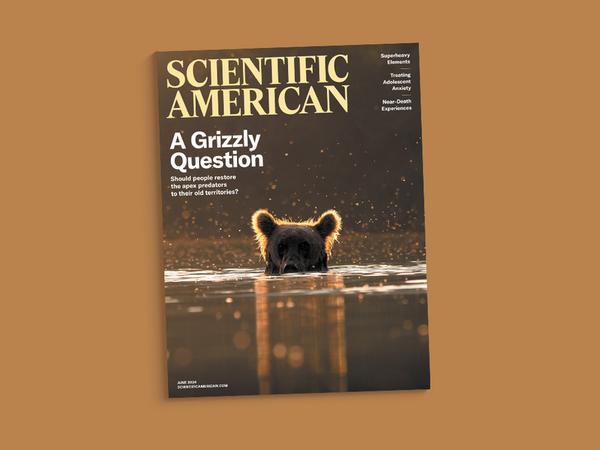
A bold experiment to undo some of the damage people have done to wildlife will likely start soon in Washington State. The U.S. Forest Service and the National Park Service announced this spring that they want to move forward with a plan to reintroduce grizzly bears in the North Cascades mountain range. Journalist Benjamin Cassidy reports on how this controversial plan began and what we’ve learned about grizzlies in other recovery areas as they have begun to come back after being eliminated from much of the U.S. The fabulous photography is by Brooke Bartleson; read more about her in our Contributors column.
Chemistry gets weird at the far end of the periodic table. The elements with atomic numbers 104 through 118 do not exist in nature as far as we know, and they only fleetingly exist in high-power physics laboratories. But as science journalist Stephanie Pappas explains, new research at the “uncharted coastline of chemistry” reveals that these oddities are even odder than expected, with relativistic forces acting within their atoms that are similar to those that govern objects around a black hole. It’s another great case of the very small helping us grasp the very large, with implications for what happens in a supernova.
Some people who recover from a cardiac arrest or another major medical trauma report having had a “near-death experience.” They may remember a sense of transcendence and transformation and visions of lost loved ones. Author Rachel Nuwer describes how scientists have started studying these experiences to understand the almost-dying brain and what altered states of consciousness can tell us about the mind.
Anxiety disorders are becoming more common in teens. They are undertreated, and existing therapies don’t help everyone. Neuroscientists BJ Casey and Heidi Meyer discuss treatments that could enable young people to control distressing fears, memories and thoughts. Please enjoy this issue and spread the word that science is never done.