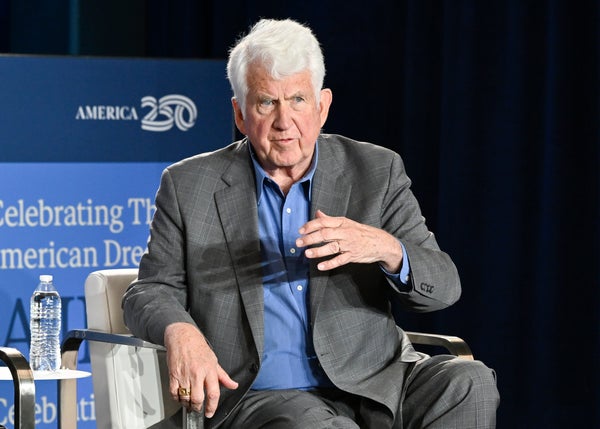
Robert Metcalfe is an American engineer and entrepreneur who co‑invented Ethernet, a foundational technology for computer networking. A pioneer of the Internet era, he co-founded 3Com and received the 2022 A. M. Turing Award for his contributions to communication technology. He is also a professor emeritus of engineering at the University of Texas at Austin.
[This interview was edited for length and clarity.]
How would you describe the current state of American science?
On supporting science journalism
If you're enjoying this article, consider supporting our award-winning journalism by subscribing. By purchasing a subscription you are helping to ensure the future of impactful stories about the discoveries and ideas shaping our world today.
First, a disclaimer: I am an engineer, and the world makes a big distinction—wrongly, I think—between engineers and scientists. I was in a bus once, going to the White House to get the National Medal of Technology [and Innovation], and I was sitting next to this codger. And I shared with him how excited I was with this White House thing. And he turned to me, and he said, “It's pretty nice, but it’s much better in Stockholm.” So there’s that old science/engineering thing. Anyway, I’m an engineer. I’m proud of it. There is a general fear among scientists I’ve detected that science is not being valued properly, and we need to defend it. And I have a very firm position about this, and I’ve said it 100 times, so it’s going to sound canned: When science is attacked, our first impulse should not be to defend it. Our first impulse should be to fix it.
The peer-review system is corrupt, and the fact that we rely on it is not helpful. You know, “I approve your paper, you approve my paper.” That’s not good, so we should fix that. The tenure system is broken. It’s bad management, bad allocation of human resources. I spent eight years teaching [at Stanford University], and the tenure system was not helpful. You had a lot of dead wood laying all over the place, and you couldn’t clean it up because everybody had tenure. In a well-run company, people come and go based on their commitment, their power, what they know. Tenure screws that all up.
So in summary, science is currently terrified by what’s happening in Washington, [D.C.], and we’re all being called to arms: the National Academies of Sciences, Engineering, and, Medicine, the IEEE [Institute of Electrical and Electronics Engineers]—they’re all, “Let’s defend science.” And I’m saying, “Let's put all our energy into fixing it.”
What needs to change in American science?
Publishing is a well-known broken part of science. So the theory goes that there’s so much pressure to produce papers, people are producing papers by cheating or by being sloppy, either one. And then later, after they’re published, this is discovered, and then there’s a retraction, and the retraction rates are going up. We need to fix that. And then they link tenure to publications, and you can’t get tenure unless you write a bunch of papers, and that’s not good.
I’m biased because I’m a deck person; I’m not a paper person. I was on the board of the company that produced PowerPoint, so I’ve been using it since the beginning. I did write one really cool paper in 1976, and I’ve been living off that paper ever since. And it was peer-reviewed, but I’m not a paper person. Right now science is paper-oriented, it’s not deck-oriented, and that slows things down considerably, and it also opens the temptation for sloppiness or cheating. And then the big-time tenured professors will blame all their retractions on the lowly postdocs and Ph.D. students, and so on. We shouldn’t accept that.
What gives you optimism right now?
I think the United States of America has a fabulous community of scientists. It’s the system that’s broken, not the people who are broken, and I think that’s a cause for optimism.
What’s your best advice for an early-career scientist?
Whatever you do, it should be fun. Because if it’s not fun, you won’t do it very much, which means you won't get very good at it. So to be good at it, it has to be fun. That’s the insight. It has to be fun in order for you to be good at it. And we want you to be good at it because we need you to be good at it.
Actually, that’s not fair. In a frank analysis of my motivations 50 years ago, [it] was not just fun; it was money, too. Choose a field that has money. If you want to help fix the world, you should follow the money—if you choose a field that has not organized itself enough to have resources to proceed, you probably shouldn’t do that until they fix it. They’ll fix it eventually, and then you can join it, but don’t join it now; follow the money.
How has your field changed in the past few years?
It depends what my field is. The past few years, I’ve been a professor of innovation in the School of Engineering at the University of Texas [at Austin]. That was my fifth career. I’m in my sixth career now.
When I was prospering in Silicon Valley, most of the movers and shakers were engineers. And when my company went public, we raised $11 million in our public offering. Elon [Musk] is planning a trillion-dollar IPO [initial public offering] shortly. [Editor’s Note: Musk’s company SpaceX went public on June 12, after Scientific American spoke with Metcalfe.] So that has changed. The scale went up. My company sold products mostly to technical people, and now that same company—which is now part of [Hewlett Packard Enterprise]—is selling to regular people, and there’s many more of them, and they have different requirements.
And so that’s changed; that is, who’s important in innovation related to information technology. It’s escaped the nerds. We nerds have lost control of it, and now it’s being run by lawyers and marketing people. From a few nerds to a lot of suits. Advice I give in the starting of a company: if you want to have a good company, the nerds and the suits have to get along. They’re natural enemies, but they have to get along, or you don’t have a company.