
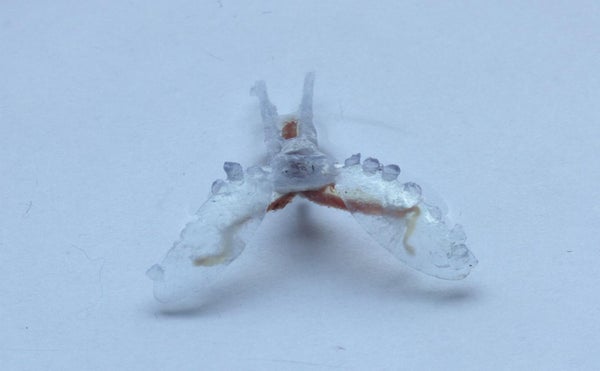
We usually think of cyborgs as part human, part machine, but roboticists don't limit themselves that way. Researchers have developed a hybrid robot built with body parts from a novel source: sea slugs.
The new robot combines a Y-shaped muscle from the mouth of a California sea hare (Aplysia californica) with a 3D-printed skeleton.
Researchers surgically removed the so-called "I2" muscle from the mouths of sea slugs and glued them to flexible, 3D-printed plastic frames. When the muscles were subjected to an external electric field, the resulting contractions produced a deliberate clawing motion that was able to move the tiny robot up to 0.2 inches (0.5 centimeters) per minute. [The 6 Strangest Robots Ever Created]
On supporting science journalism
If you're enjoying this article, consider supporting our award-winning journalism by subscribing. By purchasing a subscription you are helping to ensure the future of impactful stories about the discoveries and ideas shaping our world today.
The robot was modeled after the way sea turtles crawl, because the researchers wanted to create something that could move with only one Y-shaped muscle, study lead author Victoria Webster, a graduate student at Case Western Reserve University in Cleveland, told Live Science in an email. But, it should be possible to apply similar techniques to create more complex robots with different movement styles, such as the inchworm-inspired version that the team is working on now, she added.
With a few more developments, the scientists said, teams of robots could be deployed for tasks such as searching for toxic underwater leaks or finding an airplane's "black box" flight data recorder after it has crashed into the ocean.
And one day, the designers would also like to make entirely biological robots by replacing the plastic parts of the new hybrid bot with organic material.
"We're building a living machine—a biohybrid robot that's not completely organic—yet," Webster said in a statement.
Sea slugs live in a wide range of temperatures and conditions, so their muscles can function in myriad environments. This natural versatility is key to developing biological machines that are capable of operating in different environments.
"By using the sea hare as our material source, we have obtained materials which are more robust than the cells which have been used in the past," Webster said.
The team is now experimenting with including the ganglia, or nervous tissue, that controls the I2 muscle. "They respond to direct chemical stimulation or to stimulation of the sensory system nerves," Webster said. "By stimulating the nerves, we may be able to steer the robot in the future."
The scientists also developed a method to mold collagen gel from the sea slugs' skin into "scaffolding" for completely organic machines. These nonhybrid robots would be inexpensive, nonpolluting and biodegradable, the scientists said, enabling them to release many robots without having to worry if some of them are lost.
"Our hope is to continue developing these devices to include organic controllers, sensors and skeletons," Webster said.
The study's findings were published online July 12 in the journal Biomimetic and Biohybrid Systems.
Copyright 2016 LiveScience, a Purch company. All rights reserved. This material may not be published, broadcast, rewritten or redistributed.