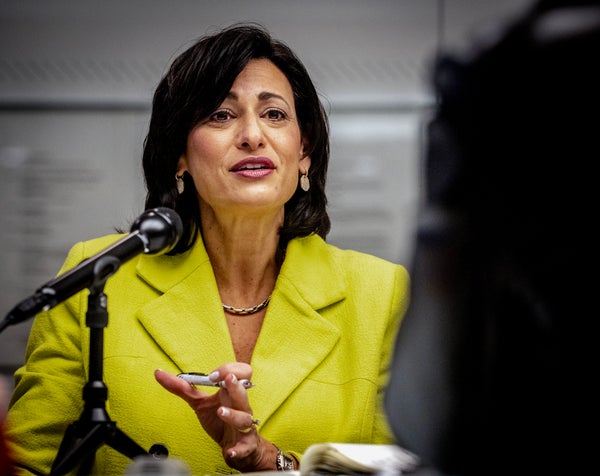
Rochelle Walensky is an infectious diseases doctor who served as director of the Centers for Disease Control and Prevention from 2021 to 2023, during the height of the COVID pandemic. Prior to that, she was chief of the division of infectious diseases at Massachusetts General Hospital and a professor of medicine at Harvard Medical School, where she currently holds that same title.
[This interview was edited for length and clarity.]
How would you describe the current state of American science?
On supporting science journalism
If you're enjoying this article, consider supporting our award-winning journalism by subscribing. By purchasing a subscription you are helping to ensure the future of impactful stories about the discoveries and ideas shaping our world today.
I think part of the issue is how we define science. If we mean the big picture, the federal funding toward science, I think American science is under threat. I think it’s in jeopardy. I think it’s remarkably fragile. So many young people who have this amazing talent and want to hit the pedal to the metal are scratching their heads and saying, “Is this a feasible career for me? Can I make it in these times?” And so we have this crazy juxtaposition of promise and talent and enthusiasm and excitement and ... this funding mechanism, this sort of dark cloud of threat that is looming over these incredibly talented people.
What needs to change in American science?
I think that dark cloud has to pull away. On a macro level, there has to be promise and capacity so that if you are a young, talented scientist, you know there is a viable career path. Many of these folks are not looking to make it rich. They’re looking to improve the humanity and improve the world, but if you can’t do that because there’s no funding, then that is certainly one thing that has to change. So the stability of the funding, the vision of a pipeline of young investigators to be able to do this work.
There are lots of things sort of a layer deeper. The peer-review process is really hard. And I don’t mean to say, like, there shouldn’t be peer review. But some folks are taking a year or two to get a paper published because it has four layers of revisions. And because there are four layers of revisions..., the paper doesn’t get [published quickly enough], and the academic appointment doesn’t happen, and then you need that paper to get the next grant. There’s this bureaucracy around good peer review that makes it hard to function right now. Just like medicine is getting buried in administrative overload, science is getting buried in administrative overload. I think if you mapped people’s calendars as to the amount of time that they’re doing those [administrative] activities, it really is diminishing the amount of science that’s getting done, and there isn’t a mechanism to handle that. So we need we need good scientists working at the top of their game, and we need [administrative] support.
What gives you optimism right now?
The young people. By virtue of working in a medical school and working in a school of public health, I get to be around young people all the time. My work has been in HIV. I went into HIV research in 1995 because everybody coming into the hospital at that point was dying of AIDS. And in my career, which I’d like to think isn’t over, we have the potential to tell people, “You’re going to live a normal life expectancy when we treat you, and if you take your medicines, you can’t transmit to other people.” And so that promise of what we can do is really extraordinary. And certainly, even in the past five years, with COVID, we lost more than 1.2 million people in this country. We’re still losing too many, but it’s nothing close to that anymore. [I’m optimistic about] the people who want to devote their lives to this work. To hear about some of their most creative ideas and how they’re going to [carry them out], some of these folks are bridging divides you would have never thought possible..., disciplines you would have never thought possible. And now we have lots of technology to make those things come alive. And these young people want to make it happen.
What is your best advice for early-career scientists?
You know, perseverance—because ... making it as an early-career scientist in these times means that you rose to the top, and we need you. And I do believe, after periods of darkness, there will be light. After every one of those dark times [in the past], there has been motivation to move forward, there’s been bright [spots], and so we need to stick through these dark times, we need to persevere.
How has your field changed in the past few years?
The field of HIV has changed dramatically. [So has cancer research.] For my husband, who’s a pediatric oncologist, those kids that he treats are cured now. So when you look at something like cystic fibrosis, like many, many diseases that really were devastating, we now have really great treatments. HIV has been a remarkable ride. COVID has been a remarkable ride, just to see the scientific process. There’s a lot of scientific creativity, where people are really bridging different disciplines, where I think that’s where magic happens.
What’s the biggest thing you were wrong about, and how did you learn from that?
I think wrong is a strong word. Maybe I will say that so much of what I did during [my tenure leading the] CDC was an underappreciation for having what might be the most scientifically sound answer versus how you communicated it and the real importance of how it gets communicated—the famous quote from George Bernard Shaw that “the biggest challenge in communication is the illusion that it has taken place.”
Who is an unsung hero of the science world?
I’m going to say the people of the CDC.