
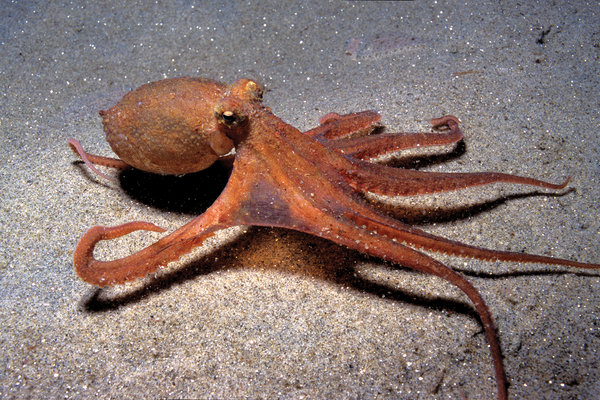
Several octopuses might have recently become the happiest individuals in their species' history when researchers gave them MDMA—the party drug often called Molly or Ecstasy. This may sound like a contender for an “Ig Nobel Prize,” but the scientists behind the study, published in October in Current Biology, say tripping cephalopods can help us better understand the roots of sociability throughout the animal kingdom—including in people. “As human beings, we like to know where we came from,” says Gül Dölen, a neuroscientist at the Johns Hopkins School of Medicine and co-author of the new paper. “MDMA is an amazing tool for studying social behaviors across multiple species.”
MDMA (short for “3,4-methylenedioxy-methamphetamine”) binds to transporter proteins in neurons, vastly increasing the availability of the signaling chemical serotonin. This flood of serotonin produces feelings of euphoria and sociability. Most research on the drug has been conducted in mice and rats, which respond similarly to how people do.
Rodents and humans diverged on the evolutionary tree around 75 million years ago, but a 500-million-year gulf separates us from octopuses. The cephalopods' invertebrate brains are vastly different from our own; they lack regions such as the cortex, basal ganglia and nucleus accumbens that we normally associate with complex interpersonal behaviors. Investigating how serotonin affects a creature so ancient and different from humans—far more so than, say, a rat—can illuminate whether the signaling chemical has always played a role in mediating friendly interactions or whether that function evolved more recently, Dölen says.
On supporting science journalism
If you're enjoying this article, consider supporting our award-winning journalism by subscribing. By purchasing a subscription you are helping to ensure the future of impactful stories about the discoveries and ideas shaping our world today.
Dölen and her co-author Eric Edsinger, a research fellow at the Marine Biological Laboratory in Woods Hole, Mass., placed pairs of sober California two-spot octopuses—a typically antisocial species—in tanks together. One animal in each pair was secured under a mesh pot that allowed it to see, smell and touch the other octopus but prevented the two from fighting. As expected, the free-swimming octopuses chose to spend most of their time on the other side of the tank, as far as possible from the caged ones.
That completely changed when the uncaged octopuses were exposed to a tank containing dissolved MDMA and reintroduced to the experimental tank. Like humans at a rave, the drugged cephalopods relaxed their posture, moved their arms and somersaulted through the water as though they were dancing. They also spent significantly more time near their caged partners, sometimes attempting to touch them and even adopting a hugging posture around the mesh container.
The octopuses' raverlike reactions suggest that the human brain regions so closely associated with social bonding and affability may be evolutionary accidents rather than necessary elements, Dölen says. “This reiterates the importance of understanding function [at] the level of molecules,” she adds. “Focusing on brain regions does not give us the whole story.”