
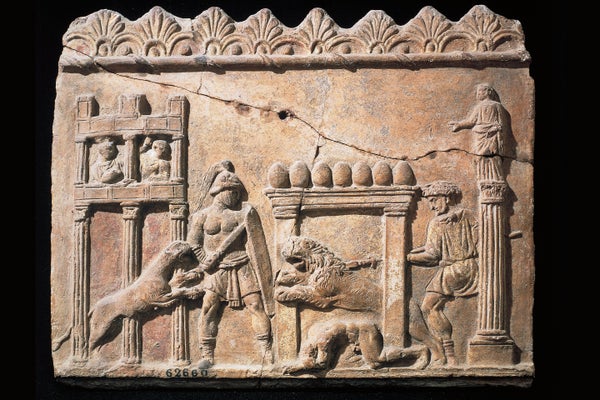
Roman gladiators’ fights to the death have inspired morbid fascination for millennia. But for something seemingly so well-documented, it’s rare for archaeologists find physical evidence of such combat in the form of Roman gladiators’ remains. Most of what we know about the fights comes from indirect records, such as texts or illustrations that described the bloody, raucous events. Among such records, some depicted so-called beast hunts, in which gladiators were pitted against predators that included lions, tigers and even elephants.
Now archaeologists have found the first physical evidence of a gladiator locked in combat with one of these animals—which appears to have left a huge, lion-sized bite mark on the fighter’s butt. The findings were published on Wednesday in PLOS ONE.
Tim Thompson, a forensic anthropologist at Maynooth University in Ireland, spends a lot of time examining the disfigured skeletons of people who died long ago. Around 2017 he was studying human remains uncovered during a 2004 excavation of Driffield Terrace—a site in York, England, that evidence suggests was a gladiator burial ground during the Roman Empire. Thompson and his colleagues were quickly drawn to a skeleton that sported a weirdly shaped bite marks on its pelvis.
On supporting science journalism
If you're enjoying this article, consider supporting our award-winning journalism by subscribing. By purchasing a subscription you are helping to ensure the future of impactful stories about the discoveries and ideas shaping our world today.
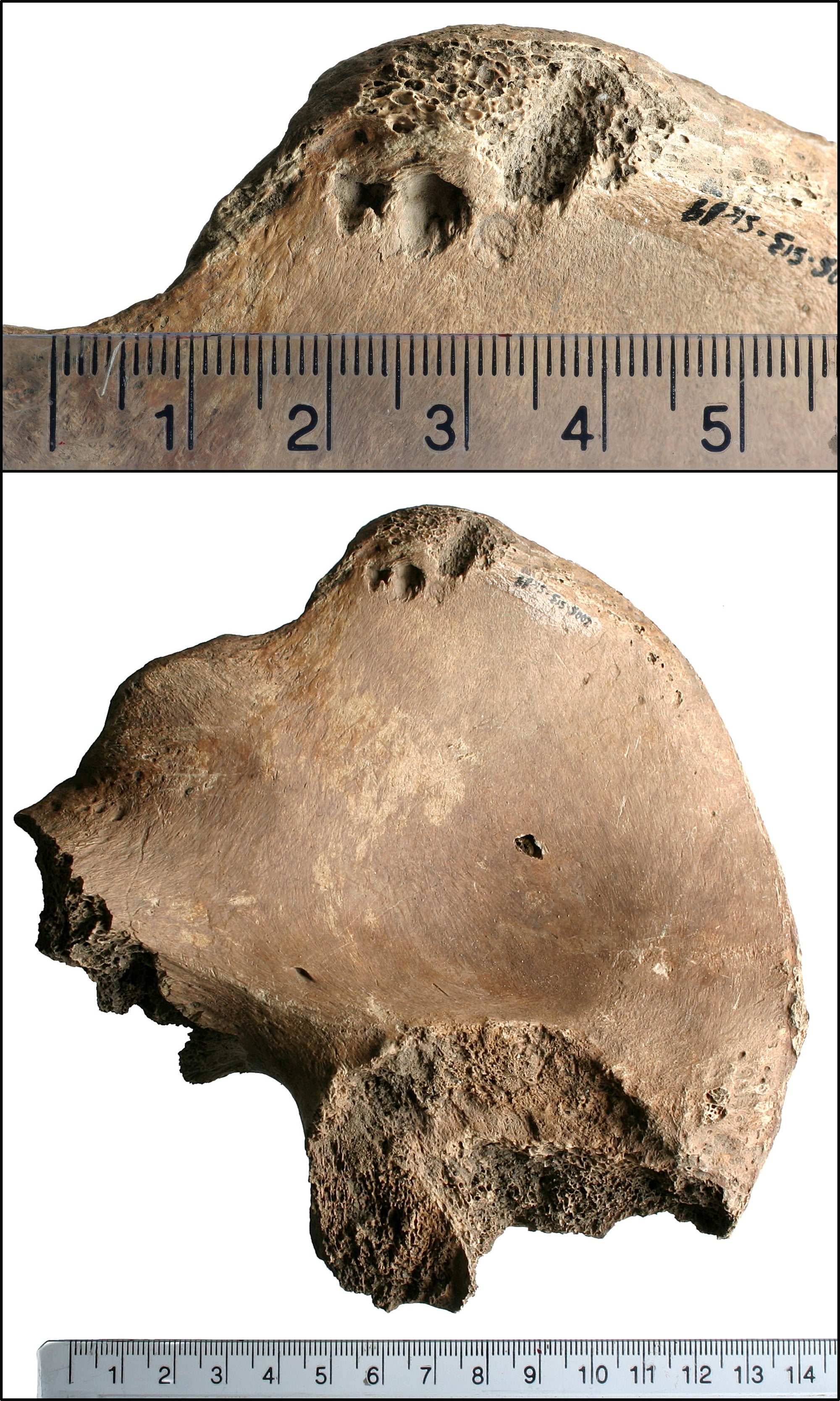
Lesion on the right ilium of 6DT19.
“Unique osteological evidence for human-animal gladiatorial combat in Roman Britain,” Timothy Thompson et al., in PLOS ONE, Vol. 20, No. 4, Article No. e0319847. Published online April 23, 2025

Lesions on the left iliac spine of 6DT19
“Unique osteological evidence for human-animal gladiatorial combat in Roman Britain,” Timothy Thompson et al., in PLOS ONE, Vol. 20, No. 4, Article No. e0319847. Published online April 23, 2025
When the bones were first unearthed, archaeologists wouldn’t have had the technology to probe the intriguing marks much further. Thompson and his team wanted to know what caused them—and now had the laboratory techniques to find out. They collaborated with zoos to create three-dimensional scans of bite marks on leftover carcasses that were made by types of animals, such as lions and cheetahs, that had been used in Roman gladiatorial shows.
They also chemically analyzed the ancient Roman bones to confirm other traits, such as the deceased person’s sex and nutritional condition—clues that could help determine whether this skeleton could truly have come from a Roman Empire–era gladiator. The researchers say they were also able to estimate that the injury’s timing was roughly concurrent with that of the fighter’s death.
The team compared the scans of the modern carnivore bites to those on the ancient bones. The likely culprit of the latter: a lion. Marble artifacts from Roman Britain depict lions mauling gladiators, Thompson says, but no confirmed archaeological evidence had been found. Some experts have also speculated that if this human-animal combat indeed occurred, it only happened in Rome—not in the far-flung edges of the empire. “The assumption has always been that maybe that [artifacts from Roman Britain] are just reflections of things happening in Rome, almost tapping into Roman myth,” Thompson says. “What we’re suggesting now, actually, is that we have evidence for that spectacle happening [here in York].”
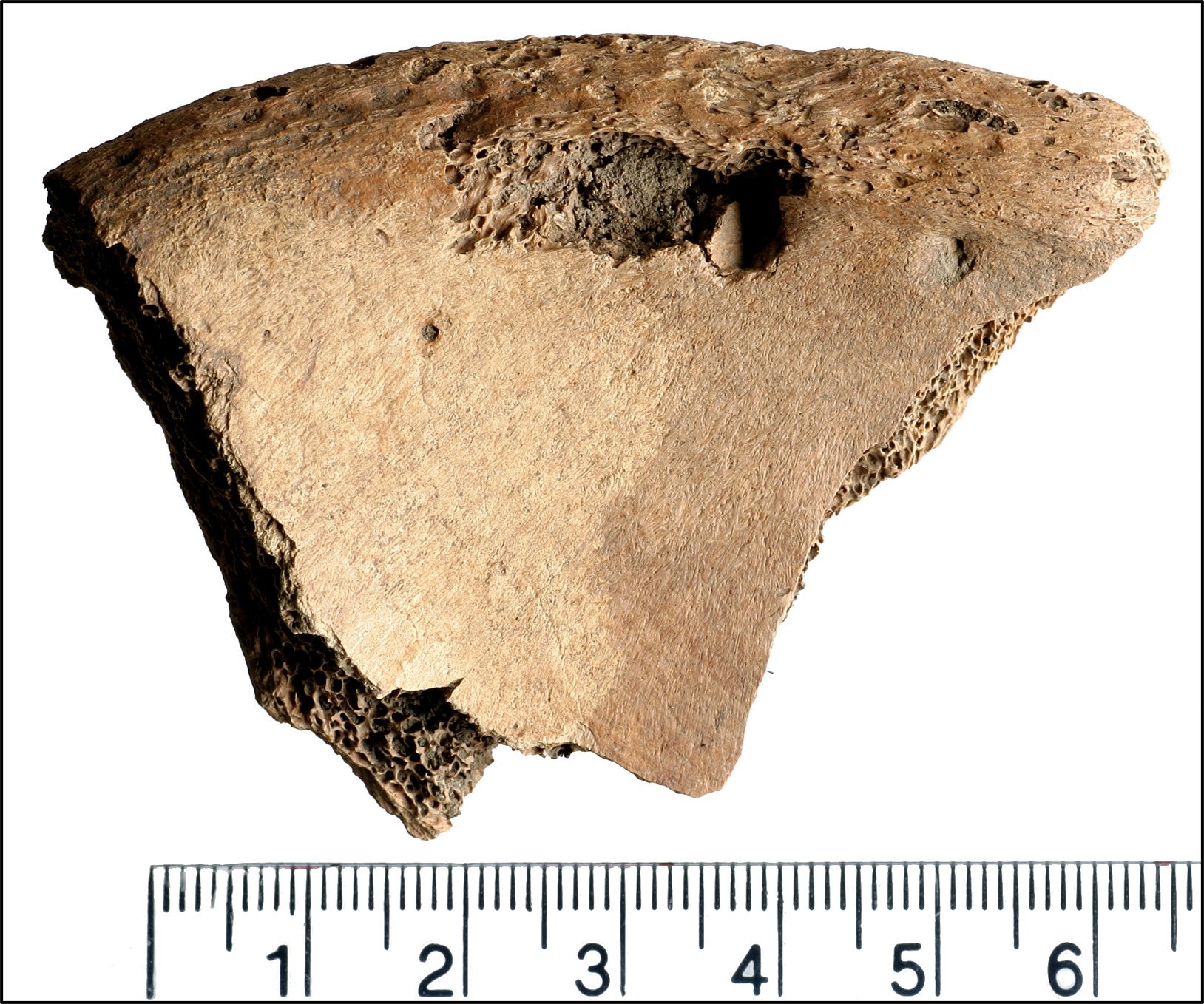
Lesion on the left iliac spine of 6DT19.
“Unique osteological evidence for human-animal gladiatorial combat in Roman Britain,” Timothy Thompson et al., in PLOS ONE, Vol. 20, No. 4, Article No. e0319847. Published online April 23, 2025.
The new finding not only offers fascinating clues into the culture of gladiatorial combat but also highlights the astonishingly far-reaching influence of the Roman Empire. “This was one of the key ways that Roman culture was spread—a spectacle,” says Anna Osterholtz, a bioarchaeologist at Mississippi State University, who was not involved in the new study. “Because you would also have executions that would be taking place as part of the games, it taught things like social roles and social norms.”
Kathryn Marklein, a biological anthropologist at the University of Louisville, who was also not involved in the study, points to the exorbitant cost these fights would have incurred. Lions are not native to England, so it would have required considerable expense and effort to bring the animals all the way to York. “Putting this quantity of resources into an event is a testament to the importance of violent spectacles in Roman provinces,” Marklein says.
Skeletal remains can reveal a great deal about pieces of human history that would otherwise be lost to time. “Our lives are inscribed into our bones,” Osterholtz says. These remains can tell us about “people’s lives that weren’t considered important enough to be written down, that were never part of the official record.”