
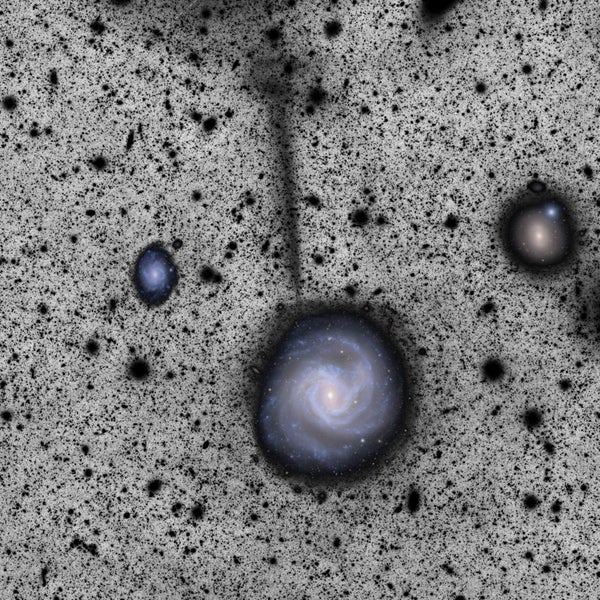
Mere months after its long-awaited debut, the Vera C. Rubin Observatory is beginning to deliver on its promise to rewrite cosmic history. The observatory’s colossal camera — perched atop a mountain in Chile — has yet to begin its official scientific survey. But just by perusing its first test image, astronomers have uncovered a surprise: a trail of light — called a stellar stream — extending from a well-known galaxy, suggesting that the galaxy once tore apart a much smaller one.
“This is the first stellar stream detected from Rubin,” says Sarah Pearson, an astrophysicist at the University of Copenhagen. “And it’s just a precursor for all of the many, many features we’ll find like this.” The authors reported their findings in the Research Notes of the American Astronomical Society.
A tail that tells tales
On supporting science journalism
If you're enjoying this article, consider supporting our award-winning journalism by subscribing. By purchasing a subscription you are helping to ensure the future of impactful stories about the discoveries and ideas shaping our world today.
The galaxy, named Messier 61, was first spotted in 1779 in the Virgo Cluster of galaxies and has caught the gaze of astronomers ever since. Hosting a slew of supernovae and churning out new stars at a surprisingly high rate, Messier 61 is what’s known as a starburst galaxy owing to its bounty of stellar activity.
Astronomers have enlisted some powerhouse telescopes — including the James Webb Space Telescope and the Hubble Space Telescope — to unravel the galaxy’s structure. But “despite all of this intense study, no one had ever found this stellar stream”, says Aaron Romanowsky, an astronomer at San Jose State University in California and an author of the study.
After scrutinizing Rubin’s first image — captured by the world’s largest-ever digital camera — the team filtered out excess light to reveal the galaxy’s stellar stream. The trail of stars is 55 kiloparsecs or 180,000 light years long, making it one of the longer streams discovered. It probably originated from a dwarf galaxy that was shredded apart by Messier 61’s gravity. Such an interaction could have boosted star formation in Messier 61 and might begin to explain some of the galaxy’s abnormalities, the authors note.
Rubin’s first image captures ten million galaxies, and it’s only an appetizer for the observations to come. Over the next decade, Rubin will capture light from 20 billion galaxies — more than any other observatory so far.
“The expectation is that every single galaxy should be surrounded by these streams. It's a fundamental part of how the galaxies are made,” Romanowsky says. “We just need to look fainter, and that’s the hope with Rubin.”