
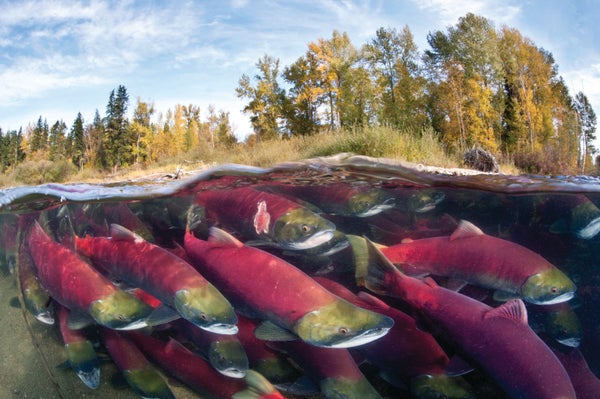
The slime that sloughs off the skin of Alaskan salmon might become the latest tool for measuring their numbers and protecting populations—an effort that could be vital to keeping the wild fish on dinner plates for years to come. Researchers recently counted the number of salmon migrating through a narrowed waterway for fish, or weir, in southeastern Alaska by measuring DNA in the bodily waste they shed into a stream as they headed to spawning grounds.
Scientists have been developing this approach, which relies on eDNA (or environmental DNA), for years. They can determine a fish species’ presence and get a general idea of its abundance by measuring the amount of its DNA in a sample of water. But to maintain salmon populations in a commercial fishery worth more than $500 million a year, managers need a more accurate way to count fish that return from the ocean to spawn. Salmon use thousands of streams throughout Alaska; biologists can count them only at a small subset because of the costs of traveling to remote locations, building weirs that funnel the fish for counting and paying biologists who can accurately identify salmon species.
In the new study, Taal Levi, an assistant professor of fisheries and wildlife at Oregon State University, and his colleagues collected daily eDNA samples at a counting station at Auke Creek and compared their results with human counts of sockeye and coho salmon. They also recorded streamflow, which affects how much eDNA is present. After accounting for the flow rate, Levi and his team accurately matched eDNA concentrations with numbers of salmon counted. They reported their findings online last December in Molecular Ecology Resources.
On supporting science journalism
If you're enjoying this article, consider supporting our award-winning journalism by subscribing. By purchasing a subscription you are helping to ensure the future of impactful stories about the discoveries and ideas shaping our world today.
The effort was a proof of concept, but Levi hopes this approach can be applied to other streams and automated to provide more cost-effective monitoring. And eDNA is already helping scientists track the movement of salmon into the Canadian Arctic, as the climate changes, by documenting their presence in new locations.
Chris Habicht, a fisheries geneticist at the Alaska Department of Fish and Game, who was not involved in the work, is skeptical that this approach can be applied broadly. He notes that biologists would need to install streamflow sensors at each site sampled—a costly endeavor in remote parts of Alaska. Study co-author Scott Vulstek, a fisheries biologist at the National Marine Fisheries Service, admits there are challenges. But not every unmonitored stream is remote, he says, and eDNA could supplement data collected at monitored sites. Moreover, he adds, “this technology is only going to get better over time.”