
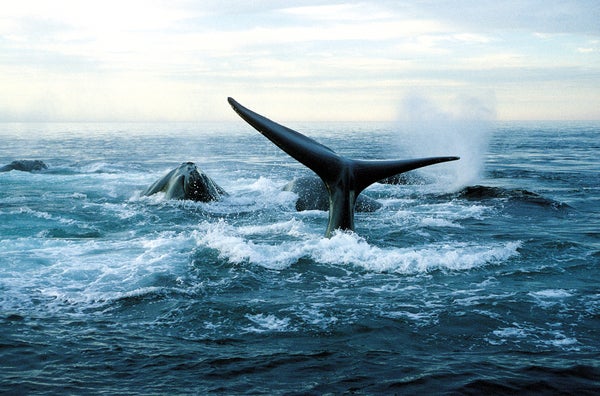
Fewer than 400 North Atlantic right whales remain in the wild, and not even 100 of them are breeding females. Their biggest survival threats are boat strikes and entanglement in fishing gear. Protecting these whales, such as by diverting boats from dangerous encounters, requires locating them more reliably—and new technology, described in the Journal of the Acoustical Society of America, could help make that possible.
To listen for marine life, researchers often deploy underwater microphones called hydrophones on buoys and robotic gliders. The recorded audio is converted into spectrograms: visual representations of sound used to pinpoint, for instance, specific whale species' calls. But those distinctive sounds are often drowned out by other noise. In recent years researchers have used a machine-learning technique called deep learning to automate this analysis, but background sounds still hinder reliability.
Now researchers have trained two deep-learning models specifically to cut through the noise. They started by giving the models thousands of “clean” spectrograms with only North Atlantic right whale calls. Then they slowly added in thousands of spectrograms contaminated with typical background sounds, such as tanker engines. The resulting algorithms can successfully turn noisy spectrograms into clean ones, cutting down on false alarms and helping spot whales before they reach dangerous areas, the scientists say.
On supporting science journalism
If you're enjoying this article, consider supporting our award-winning journalism by subscribing. By purchasing a subscription you are helping to ensure the future of impactful stories about the discoveries and ideas shaping our world today.
Shyam Madhusudhana, a Cornell University data engineer, who was not involved in the study, says he would want to see if such models could be used to locate other marine mammals, too. “Humpback whales and dolphins have much more complex speech pathways than the right whale,” he notes. And University of East Anglia machine-learning researcher Ben Milner, one of the study's authors, wants to take this technology above water as well—to Ukrainian forests, where he hopes to identify animals near the site of the 1986 Chernobyl disaster.
University of St. Andrews behavioral ecologist Peter Tyack, who was not involved in the study, says this new system should be used to figure out where whales are throughout the year, so that these areas can be protected. “In terms of estimating the density and abundance of these whales in places where it's hard to see them,” Tyack says, “this technology could be fantastic.”
But he warns that it should not be the only approach to preventing ship strikes or entanglement. In his work, Tyack has found that North Atlantic right whales can be silent for hours at a time—so passive acoustic monitoring could easily miss one. And killing just a few, he adds, “could lead to extinction of the population.”