
By Reuters Television & Darren Schuettler
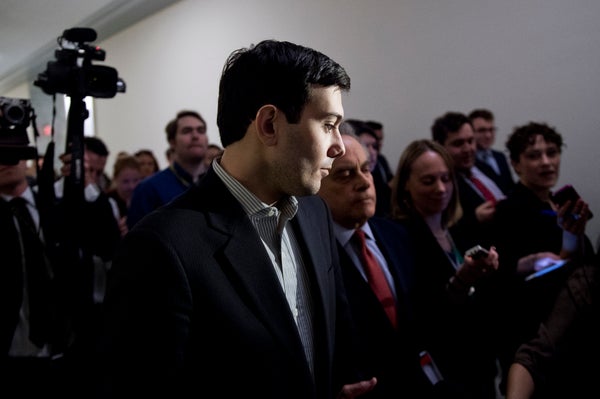
Former pharmaceutical executive Martin Shkreli has congratulated a group of Australian students who reproduced the active ingredient for a life-saving, anti-parasitic drug at the center of a drug-price controversy involving his former company.
The students from Sydney Grammar School drew global media attention this week after they said they had produced the drug Daraprim for about $2 a dose, a fraction of the current list price of $750 per dose.
On supporting science journalism
If you're enjoying this article, consider supporting our award-winning journalism by subscribing. By purchasing a subscription you are helping to ensure the future of impactful stories about the discoveries and ideas shaping our world today.
Shkreli is a former chief executive of Turing Pharmaceuticals, where he sparked outrage among patients and U.S. lawmakers for raising the price of Daraprim by more than 5,000 percent.
"These Australian students are proof that the 21st century economy will solve problems of human suffering through science and technology," Shkreli said in a video message posted on YouTube.

Martin Shkreli, a former chief executive of Turing Pharmaceuticals, drew outrage for raising the price of malaria medication Daraprim by 5,000 percent. When Australian students said they had experimentally produced the drug for just $2 a dose, Shkreli initially derided their efforts in the above tweets—but he later that said the media had misrepresented his tweets, and released a YouTube video praising the students. Source: @MartinShkreli
"We should congratulate these students for their interest in chemistry and I’ll be excited about what is to come in this STEM-focused 21st century,” he said, referring to science, technology, engineering and mathematics.
Daraprim is used to fight parasitic infections in AIDS patients, pregnant women and others.
The six students and their science teacher worked under the guidance of the University of Sydney and members of the Open Source Malaria consortium, which allows scientists to share research on anti-malaria drugs.
"We had to repeat a lot of the reactions and try different reaction conditions in order to see which materials in which things would react to make the Daraprim," student Brandon Lee told Reuters Television on Friday.
Turing made front-page headlines after it bought the rights to Daraprim in August 2015. With no rival manufacturers making the drug, Turing quickly raised the price for a tablet of Daraprim to $750 from $13.50.
Overnight, the tiny company was vilified as an example of pharmaceutical industry greed, drawing fire from politicians and medical groups. Turing later said it would cut the cost of the drug to hospitals.
Lee said the students wanted to show that "these compounds which you think are only accessible to these large, large-scale companies are actually able to be accessed and produced by ordinary citizens".
Shkreli stepped down as Turing's chief executive in December 2015 after being indicted on charges that he engaged in a Ponzi-like scheme at a hedge fund and Retrophin Inc, a company he once headed. He has pleaded not guilty.
