
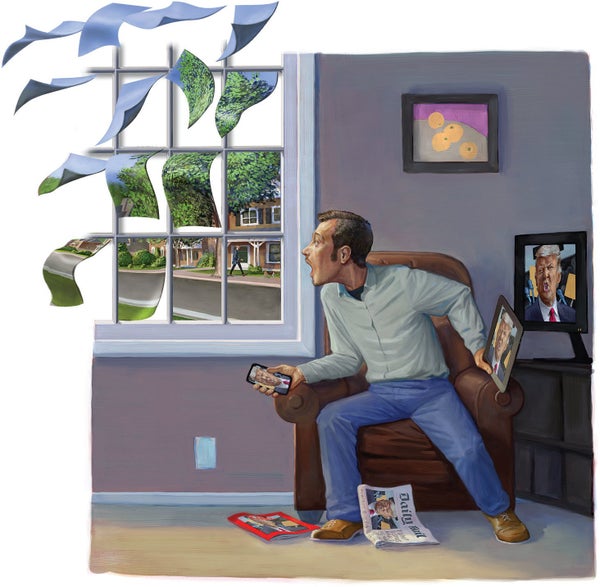
I distinctly remember the moment when I started to feel my mind go. It was Tuesday, July 31. Or what happened was that day, and I heard about it the next day. Or I saw it live as it happened. Those details are not important. The only important thing is that I remember it distinctly. President Donald J. Trump was at a rally in Florida, explaining the need for strong voter-identification laws. “You know, if you go out and you want to buy groceries, you need a picture on a card, you need ID,” he said. “You go out and you want to buy anything, you need ID and you need your picture.”
I had, of course, heard the president say many, many things over the years that were true ... I mean, not true. The Washington Post tallied 4,229 “false or misleading claims” by Trump in his first 558 days in office. Can you believe that? I could. Before my mind went.
Here's an example of my conundrum. Early this year, Trump refuted the idea of climate change: “The ice caps were going to melt, they were going to be gone by now, but now they're setting records, so okay, they're at a record level.” But a researcher at the National Snow and Ice Data Center said that polar ice was at “a record low in the Arctic (around the North Pole) right now and near record low in the Antarctic (around the South Pole).” The Trump claim and the response were both published by the Pulitzer Prize–winning organization PolitiFact. But I don't know anyone there.
On supporting science journalism
If you're enjoying this article, consider supporting our award-winning journalism by subscribing. By purchasing a subscription you are helping to ensure the future of impactful stories about the discoveries and ideas shaping our world today.
I was reading a book. The book is called The Death of Truth. The writer's name is Michiko Kakutani. She wrote that the Trump administration ordered the Centers for Disease Control and Prevention to avoid using the terms “science-based” and “evidence-based.” She says that in another book called 1984 there's a society that does not even have the word “science” because, as she quoted from that other book, “‘the empirical method of thought, on which all the scientific achievements of the past were founded,’ represents an objective reality that threatens the power of Big Brother to determine what truth is.” Is what she wrote true? I don't know. And why can't two plus two be five? Or three. Or both at the same time. That's true freedom.
Kakutani also wrote that a man named Rush Limbaugh was on the radio and said that “The Four Corners of Deceit are government, academia, science and the media.” In my country, we're supposed to have government “by the people.” So I think I might be in the government. And I have been in academia. And I have a job in media covering science. I feel shame.
Maria Konnikova is a science journalist. She also has a doctorate in psychology. So she should feel shame, too. She wrote an article for a place called Politico entitled “Trump's Lies vs. Your Brain.” She wrote, “If he has a particular untruth he wants to propagate ... he simply states it, over and over. As it turns out, sheer repetition of the same lie can eventually mark it as true in our heads.” She also wrote that because of how our brains work, “Repetition of any kind—even to refute the statement in question—only serves to solidify it.”
Anyway, groceries. I was sure that I had bought groceries at some point during the week before the president said that I would have needed to show a picture ID to buy those groceries. And I did not remember showing or even being asked to show a picture ID to buy those groceries. The cashiers usually only wanted pictures of Alexander Hamilton or Andrew Jackson against a green background—these pictures are money. Or my credit card, which does not have my picture on it. I'd need to look at it again to say for sure whether it has my picture on it.
And so I started to remember showing my photo ID to buy groceries. Everything was all right. The struggle was finished. I had won the victory over myself. I loved Big Lying.