
What is science worth? For many researchers, the answer is “priceless.” It's not just that science has provided the basis for modern life through sanitation and energy and electricity and telecommunications or that technology gives us useful things. It's that science deepens our understanding of the world around us in a way the transcends material benefits. Poet William Blake may not have been thinking about science when he described seeing “a World in a Grain of Sand/And a Heaven in a Wild Flower,” but he could have been. To me, the deepest value of science is the way in which it can make us feel connected to the scale of the universe, the power of natural forces.
That said, science can be expensive, and recently some researchers have raised challenging questions about one particular cost: its carbon footprint. Large-scale scientific research uses a lot of carbon-based energy and emits a very large amount of greenhouse gases, contributing to our current climate crisis. So, even while scientists are helping us to understand the world, they are also doing some damage to it.
In a recent case study of computer science, Steven Gonzalez Monserrate—a researcher at the Massachusetts Institute of Technology—argues that the environmental costs of this research field, particularly computer cloud storage and data centers, are huge and rising. The cloud, he contends, is a “carbonivore”: a single data center can use the same amount of electricity as 50,000 homes. The entire cloud has a greater carbon footprint than the entire airline industry.
On supporting science journalism
If you're enjoying this article, consider supporting our award-winning journalism by subscribing. By purchasing a subscription you are helping to ensure the future of impactful stories about the discoveries and ideas shaping our world today.
And the carbon problem in research is hardly limited to computer science.
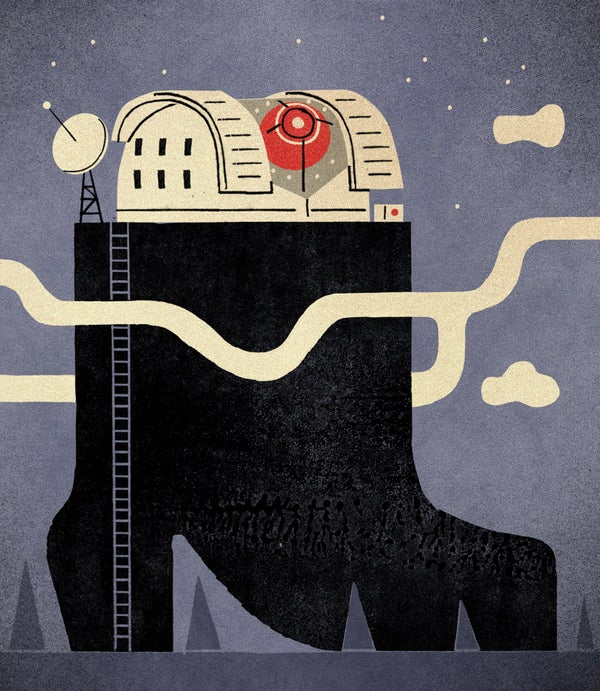
Large astronomical observatories and space-based telescopes are big emitters. One study, published earlier this year in the journal Nature Astronomy, found that over the course of their lifetimes the world's leading astronomical observatories will produce about 20 million metric tons of carbon dioxide equivalent (CO2e). In a news conference announcing their results, the authors said that if the world is to meet the challenge of net-zero greenhouse gas emissions by 2050, astronomers will have to reduce the carbon footprint of their research facilities by up to a factor of 20. That might mean building fewer big observatories. When these researchers analyzed their own facility, the Institute for Research in Astrophysics and Planetology (IRAP) in Toulouse, France, they found the average greenhouse gas emissions per person were 28 metric tons of CO2e a year, compared with 4.24 metric tons per person for the average French citizen.
Other scientists have focused on the carbon footprint of research conferences. One of climate science's most important gatherings is the annual meeting of the American Geophysical Union (AGU), usually held in San Francisco. Climate modeler Milan Klöwer and his colleagues calculated the travel-related carbon footprint of the 2019 AGU meeting at 80,000 metric tons of carbon dioxide—about three metric tons per attending scientist. That per person output was almost as much as the annual output of an average person living in Mexico. Klöwer offered footprint-reducing ideas: moving the meeting to a central U.S. city to shorten travel, holding the conference biennially and encouraging virtual participation. Taken together, these changes could reduce the travel footprint by more than 90 percent. The AGU has said it plans to rotate locations in the future and use a hybrid meeting format.
But as the analyses of astronomy and computer science show, it's the research, not just travel, that enlarges the scientific carbon footprint. Emma Strubell, a computer scientist at Carnegie Mellon University, and her colleagues concluded—in a study that has not yet been peer-reviewed—that from a carbon budget standpoint, the extreme amount of energy spent training a neural network “might better be allocated to heating a family's home.” Similar complaints have been raised about bioinformatics, language modelingandphysics.
This is a hard reality to face. But as time runs out to prevent a climate calamity, scientists will have to find a way to do more of their work with much less of our energy.