
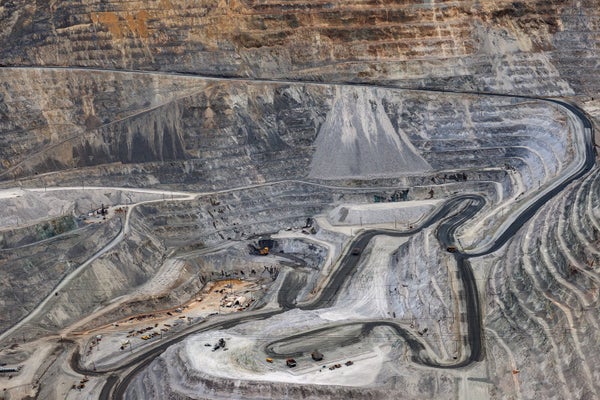
Copper, lead and zinc are essential for modern technology's electronics and batteries. Demand has skyrocketed, and mining companies are depleting known deposits faster than prospectors can find more. Now an international team of scientists has discovered a relationship between deposits of these metals and the thickness of the lithosphere (the earth's crust and upper mantle), providing a reliable way to locate these crucial resources.
The project began by chance, says Mark Hoggard, first author of the new study and a geologist at Harvard University and Columbia University's Lamont-Doherty Earth Observatory. His co-author Karol Czarnota, a researcher at Geoscience Australia, was visiting Harvard and mentioned noticing—and wondering why—metal deposits in northern Australia seemed to align with areas where the lithosphere's thickness varies. The research team found that this connection applies globally, hinting at more places to search for the hidden ores. The study, published in July in Nature Geoscience, comprehensively maps the correlation between known metal deposits and lithosphere thickness and proposes a potential mechanism for that correlation.
The lithosphere can reach up to 300 kilometers below the surface, making its thickness “actually really hard for geophysicists to measure,” says Maureen Long, a Yale University geophysicist, who was not involved in the study. To calculate the lithosphere's thickness, seismometer readings are typically used to record how fast earthquake vibrations travel through the planet. Long notes, however, that the world's limited number of earthquakes and seismometers means “our ability to resolve the earth's structure is not perfect.”
On supporting science journalism
If you're enjoying this article, consider supporting our award-winning journalism by subscribing. By purchasing a subscription you are helping to ensure the future of impactful stories about the discoveries and ideas shaping our world today.
To create a high-resolution world map of lithosphere thickness, Hoggard and his colleagues combined and calibrated existing regional and global models, adding temperature and pressure data from lithospheric rocks carried to the surface in volcanic eruptions. They found that metal deposits tend to appear where the lithosphere is around 170 kilometers thick. Theorizing about why, they note that metal's building blocks are commonly found near the earth's surface, where they accumulate in basins. If these basins sit above a part of the lithosphere with the right thickness, the amount of heat that rises from the deeper mantle could set the perfect temperature for the constituents to concentrate into metal deposits.
Finding these metals has traditionally involved “boots on the ground,” Hoggard says, with people widely sampling mineral content in soil or measuring the earth's magnetic field to find anomalies. The team's discovery provides an opportunity to find promising sites remotely; in fact, mining companies have already begun using this information to inform their searches, Hoggard says.
“What these authors have done that's really novel is ... connecting these deeper structures in the upper mantle to something that we can see [near] the surface, which is the distribution of these metal deposits,” Long says. “It's a really exciting piece of work.”