
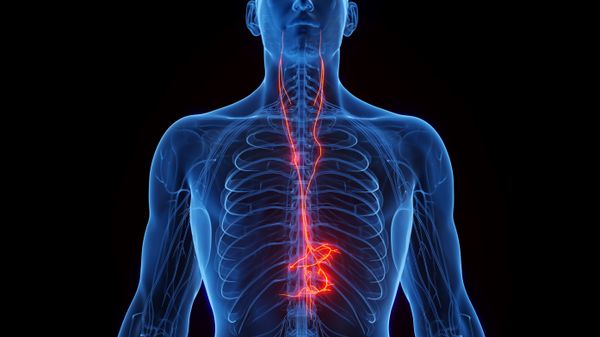
The vagus nerve is a both underappreciated and incredibly powerful instrument of the body. Researchers have long known that the vagus nerve serves as an information highway, ferrying signals between the brain stem and the rest of the body. It plays a role in everything from breathing and digestion to inflammation and immune responses. But exactly how it does this is somewhat of a mystery.
Part of the reason why is that there is no Google Maps for the body. Our internal highways are made up of intricate webs of nerves, arteries and glands that snake in and out of our organs. Tracing this inner cartography is a challenge—the vagus nerve is made up of some 200,000 nerve fibers. But doing so can unlock new understandings of what the vagus nerve does and how its role changes over time.
The vagus nerve starts in the brain and splits into the left and right side of the body, where smaller bundles of nerve fibers called fascicles shoot off into the internal organs. In a recent study, researchers examined the left and right branches of the vagus nerve in 30 human cadavers in attempt to better map the nerve.
On supporting science journalism
If you're enjoying this article, consider supporting our award-winning journalism by subscribing. By purchasing a subscription you are helping to ensure the future of impactful stories about the discoveries and ideas shaping our world today.
“We are finding that even though each vagus nerve is unique in how fibers are organized, most vagus nerves also share some common principles with regard to where certain fibers are located inside the nerve and how they reach the organs,” says Stavros Zanos, a neuroscientist at the Feinstein Institutes for Medical Research and lead researcher of the project.
The result is a public dataset that maps thousands of individual nerve fibers across the body. To create it, Zanos’s team used ultrasound imaging, which captured the basic structure; micro-computed tomography (micro-CT) imaging, which traced the fascicles’ specific paths; and microdissection, which involved cutting open the nerves themselves to understand their functions. The team also used a machine-learning model to help analyze the 60 individual nerve branches, Zanos says.
The vagus nerve’s vast range in our bodies means it is connected to nearly everything we do. It is crucial to the autonomic nervous system, which governs all of our involuntary bodily functions, such as breathing and digestion. Research into this system is “in the middle of an explosion of knowledge,” Zanos says.
That matters for patients. Scientists have targeted the vagus to treat myriad conditions, such as epilepsy, chronic pain and even depression. Those clinical decisions can now be informed by the nerve’s underlying structure, Zanos says.
“With these detailed anatomical maps, surgeons that place stimulation devices on the vagus nerve will be able to be more precise with the placement,” he adds, “and medical device engineers will be able to design devices that are more effective and safe.”