
Last weekend, a massive milieu of women in pink hats descended on Washington, D.C. for the Women’s March. The next big protest being planned for the nation’s capital could involve a sea of lab coats (and likely a few pink hats as well).
A group of researchers have proposed a March for Science. What started as a discussion on Reddit has quickly blossomed into a movement.
Organizers started a private Facebook group and Twitter account on Monday. By Wednesday afternoon, the former boasted more than 300,000 members and the latter had nearly 55,000 followers. A public Facebook page had more than 11,000 likes just five hours after going online. The explosion of support caught organizers off guard, but they’re meeting this weekend to discuss details about the date and full mission statement.
On supporting science journalism
If you're enjoying this article, consider supporting our award-winning journalism by subscribing. By purchasing a subscription you are helping to ensure the future of impactful stories about the discoveries and ideas shaping our world today.
The march would be the latest in a string of actions taken by scientists following Donald Trump’s election and his inauguration as president. His administration has been widely viewed as hostile to science — from the transition period through hearings for his cabinet nominees through silencing key federal science agencies and freezing grants.
“This is not a partisan issue. People from all parts of the political spectrum should be alarmed by these efforts to deny scientific progress,” Caroline Weinberg, a medical researcher who is helping organize the march, said. “Scientific research moves us forward and we should not allow asinine policies to thwart it.”
Researchers have been getting more vocal about the value of science and evidence-based policymaking in recent months. Earth scientists took to the streets in San Francisco last December during the annual American Geophysical Union meeting. Researchers and librarians are also racing to save climate data from federal websites. And more recently, scientists flooded Twitter during Friday’s inauguration with updates about how science impacts everyday people.
The March for Science represents a next step, with a groundswell of support behind it and the potential to dwarf the December San Francisco rally of a few hundred earth science researchers. While details are forthcoming, Weinberg underscored that scientists and science lovers of all disciplines and backgrounds will be welcome.
“Diversity in science, both in the researchers who participate and the topics we are focused on, is a critically neglected area,” she said. “We fully intend to emphasize diversity in both the planning of and mission statement for this march.”
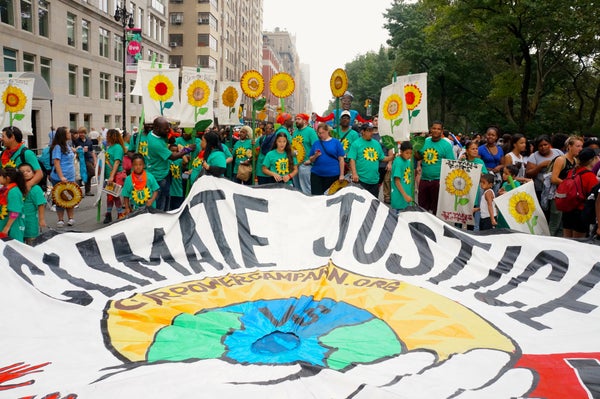
Whatever becomes of the march, it won’t be the first time scientists have turned out to protest what they view as federal policies ungrounded in science. The 2014 People’s Climate March turned out an estimated 310,000 people in New York, including a large number of climate scientists.
Naomi Oreskes, a science historian at Harvard, said that looking further into the past reveals another telling example of scientists organizing.
“It is the scientists who mobilized against the arms race in the late 1950s and 1960s,” she said. “So that tells you how scientists feel now. This is an existential threat.”
This article is reproduced with permission from Climate Central. The article was first published on January 25, 2017.