New Issue: Orbital Catastrophe Ahead? Read Now

Scientists Denounce Trump’s Plan to Kill Crucial Atmospheric Science Center

The U.S. government is dismantling the National Center for Atmospheric Research, jettisoning key climate science projects in the process

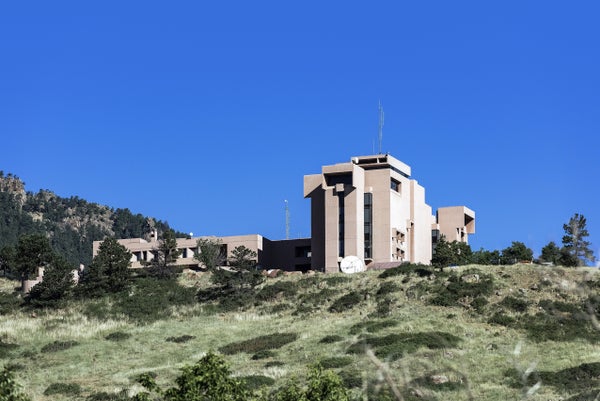
A blocky beige building atop a green hill with a blue sky in the background

Mesa Laboratory at the National Center for Atmospheric Research in Boulder, Colo.

Loop Images/Contributor via Getty Images

Join Our Community of Science Lovers!

The Trump administration is dismantling the National Center for Atmospheric Research (NCAR), long considered the crown jewel in the U.S.’s earth science infrastructure. Scientists who study climate, weather and other earth sciences have decried the move, first reported by USA Today, as “taking a sledgehammer” to an “iconic” center dedicated to studying our planet.

“NCAR is quite literally our global mothership,” wrote Katharine Hayhoe, a climate scientist at Texas Tech University and chief scientist of the Nature Conservancy, on Bluesky. “Dismantling NCAR is like taking a sledgehammer to the keystone holding up our scientific understanding of the planet. Unbelievable.”

The center, based in Boulder, Colo., has become a target because of what Russ Vought, director of the White House Office of Management and Budget, described as “climate alarmism” in a statement to USA Today. Weather modeling and supercomputing work also done at the center will be moved to other research hubs, Vought said.


On supporting science journalism

If you're enjoying this article, consider supporting our award-winning journalism by subscribing. By purchasing a subscription you are helping to ensure the future of impactful stories about the discoveries and ideas shaping our world today.


The work to dismantle NCAR, founded in 1960, will begin immediately, USA Today reported, and will involve fully closing the center’s iconic Mesa Laboratory.

“NCAR is a unique & valuable asset—far more than a climate model, or observations, or technology, or training ground, or gathering space,” wrote climatologist Gavin Schmidt, director of NASA’s Goddard Institute for Space Studies, on Bluesky. “It covers weather, space weather, data, climate, paleo-climate, and everything in-between. [Its] building is an icon, but [its] iconic status goes far beyond that.”

The NCAR dismantling is just the latest target of a series of swings the Trump administration has taken to curtail climate change research and action, including massive cuts to the National Oceanic and Atmospheric Administration and efforts to roll back Environmental Protection Agency rules to limit pollution.

NCAR employs about 830 people under the University Corporation for Atmospheric Research (UCAR), a nonprofit consortium of universities and colleges. The National Science Foundation contracts with UCAR to manage NCAR and provided about half of the center’s operating budget for 2025, USA Today reported.

Editor’s Note (12/17/25): This article was edited after posting to correct the name of the Nature Conservancy.

Andrea Thompson is senior editor for Earth and environment at Scientific American, covering the environment, energy and Earth sciences. She has been covering these topics for nearly two decades. Prior to joining Scientific American, she was a senior writer covering climate science at Climate Central and a reporter and editor at Live Science, where she primarily covered earth science and the environment. She has moderated panels, including as part of the United Nations Sustainable Development Media Zone, and appeared in radio and television interviews on major networks. She holds a graduate degree in science, health and environmental reporting from New York University, as well as a B.S. and an M.S. in atmospheric chemistry from the Georgia Institute of Technology. Follow Thompson on Bluesky @andreatweather.bsky.social

More by Andrea Thompson

Subscribe to Support Independent Journalism

Great science journalism requires human expertise, time, effort and creativity. And it costs money. That’s why I and the journalists here at Scientific American hope you’ll join our community.

When you subscribe, you are supporting staff and freelance journalists who are passionate about telling science stories that are true, important and compelling. Our editors and reporters are often experts in their fields, which means they understand the nuances of big discoveries and can untangle the breakthroughs from the hype. With a subscription, you are also supporting rigorous fact-checking to ensure the words we publish are precise and accurate. And you’re supporting original illustrations, graphics and photos that bring you closer to an advanced laboratory, an ice sheet in Antarctica or a space mission in orbit. You’re helping us craft other types of high-quality journalism as well: Our newsletters are carefully written, edited and curated by staffers you have or will come to know and love. Our Science Quickly podcast is based on original reporting, collaboration with editors and scientists and exacting production.

Subscriptions keep this engine running so we can continue to deliver thoughtful, rigorous and independent science journalism to you. In an era of viral misinformation, this work is crucial. If you value what we do, I hope you’ll consider joining us as a subscriber

Thank you,

Jeanna Bryner, Editor in Chief, Scientific American

Subscribe