
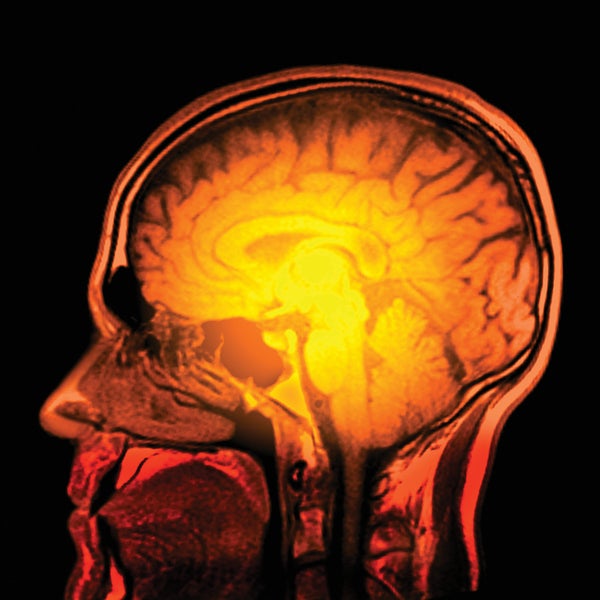
The brain’s cortex, which handles higher cognitive functions in mammals, is split into six distinct physical layers marked by varying cell types, sizes and connections—and new research suggests these layers specialize in generating different brain waves, too. Outer layers seem to process sensory input, whereas deeper layers control what the brain does with the resulting information.
The new study, published in Nature Neuroscience, shows that rapid gamma waves often originate in outer layers, whereas slower alpha and beta waves arise in the deeper ones. This holds true across 14 cortical regions and four species, including humans. “When you see [a pattern] that ubiquitous and robust, you know it’s doing something very important,” says Massachusetts Institute of Technology neuroscientist Earl Miller, one of the study’s senior authors. The findings may have implications for understanding—and even treating—neuropsychiatric conditions.
Through multiple experiments, the researchers found the same pattern in each of 14 cortical regions in five macaques. They also saw it in brain-wave recordings from humans and other primates, and they found that mouse brain waves followed the same gradient (though with a broader frequency range).
On supporting science journalism
If you're enjoying this article, consider supporting our award-winning journalism by subscribing. By purchasing a subscription you are helping to ensure the future of impactful stories about the discoveries and ideas shaping our world today.
Cortical brain layers, at less than a millimeter thick, are challenging to record from individually—so the study authors used probes containing multiple electrodes to measure all layers at once. An algorithm helped them pinpoint which layers those readings came from, and they confirmed these origins with an anatomical study.
“It’s really good that people are recording from different layers of the cortex,” says Helen Barbas, a primate neurobiologist at Boston University. “The fact they have a lot of information on this will give the impetus to others to follow.” She’s also curious what happens in cortical regions that are not as clearly divided into layers as those tested.
The researchers’ previous work suggested that high-frequency brain waves encode sensory information and that lower frequencies represent control signals. “We believe it’s literally the balance between your brain processing incoming sensory information and its control over that information,” Miller says. If this distinction is right, imbalances between these brain waves could be involved in neuropsychiatric disorders. For instance, if higher frequencies dominate (meaning the brain is processing sensory information excessively), this could cause attention problems or sensory overload. Too little high-frequency activity could be involved in psychosis because it would reduce information from the outside world, increasing the brain’s reliance on internally generated signals.
The new study suggests which layers these mismatches might originate in. Brains of people who have schizophrenia are known for reduced high-frequency gamma waves, for example. Co-lead author Andre Bastos of Vanderbilt University and his colleagues plan to check whether specific cells in shallower layers, which are likely involved in generating these waves, are dysfunctional in those with schizophrenia.