
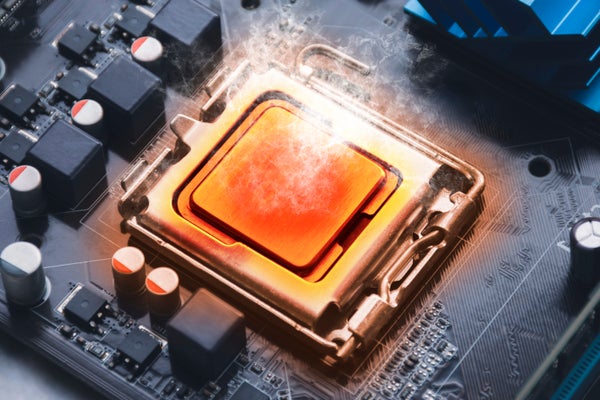
From smartphones to supercomputers, electronics have a heat problem. Modern computer chips suffer from microscopic “hotspots” with power density levels that exceed those of rocket nozzles and even approach that of the sun’s surface. Because of this, more than half the total electricity burned at U.S. data centers isn’t used for computing but for cooling. And many promising new technologies—such as 3-D-stacked chips and renewable energy systems—are blocked from reaching their full potential by errant heat that diminishes a device’s performance, reliability and longevity.
“Heat is very challenging to manage,” says Yongjie Hu, a physicist and mechanical engineer at the University of California, Los Angeles. “Controlling heat flow has long been a dream for physicists and engineers, yet it’s remained elusive.”
But Hu and his colleagues may have found a solution. As reported last November in Science, his team has developed a new type of transistor that can precisely control heat flow by taking advantage of the basic chemistry of atomic bonding at the single-molecule level. These “thermal transistors” will likely be a central component of future circuits and will work in tandem with electrical transistors. The novel device is already affordable, scalable and compatible with current industrial manufacturing practices, Hu says, and it could soon be incorporated into the production of lithium-ion batteries, combustion engines, semiconductor systems (such as computer chips), and more.
On supporting science journalism
If you're enjoying this article, consider supporting our award-winning journalism by subscribing. By purchasing a subscription you are helping to ensure the future of impactful stories about the discoveries and ideas shaping our world today.
“This invention represents a revolutionary breakthrough with immense practical applications,” Hu says. “Simply speaking, there’s been no available way for precise heat control before this.”
Electrical transistors were invented in 1947 and changed the world by enabling engineers to precisely control electricity. These devices, which are now a critical component of basically all electronics, act like switches: they consist of two terminals through which electricity flows, plus a third terminal that controls the flow. Today it’s possible to squeeze billions of transistors onto a single chip, and while this miniaturization has exponentially increased computing power, it has also made dealing with excess heat even more challenging.
With the right technology, though, wasted heat could not only be captured to prevent damage to the chip; it could also be harnessed and reused. “Today most heat in electronic circuitry is considered a nuisance, and one just tries to channel it away, whereas it should really be put to work,” says Alex Zettl, an experimental physicist at the University of California, Berkeley, who was not involved in the new study. “In the future, I suspect electronic and thermal circuitry will work hand in hand.”
During the past two decades, research teams such as Hu’s have been trying to usher in this future by developing thermal transistors to control heat flow as precisely as electrical transistors control electrical currents. Several fundamental challenges have stood in their way, however. Previous thermal transistor designs, for example, often relied on unwieldy moving parts that slow down processing times. And structural problems have also caused such devices to fail. “There’s been lots of interest in the field, but none [of these past attempts] have been successful,” Hu says.
To circumvent these limitations, Hu and his colleagues have spent a decade developing an entirely new approach to building a thermal transistor. Their technique takes advantage of the bonds that form between atoms in a nanoscale channel of the new transistor. These bonded atoms are held together by sharing their electrons, and the way these electrons are distributed between them affects the strength of the bonds. This, in turn, influences how much heat can pass through the atoms.
Hu and his colleagues found they could manipulate these variables by using a nanoscale electrode that applies an electrical field to precisely control the movement of heat. Similarly to an electrical transistor, the new device consists of two terminals between which heat flows and a third that controls this flow—in this case, with the electrical field, which adjusts the interactions between electrons and atoms within the device. This leads to changes in thermal conductivity and enables precise control of heat movement.
With the device’s invention, Hu says, heat can now “be manipulated for many applications according to our needs.” This includes preventing overheating in computers and even recapturing this once wasted energy for reuse.
The new device set records and performed better by several orders of magnitude in the team’s experiments, compared with other recently engineered thermal transistors that don’t use atomic-level bonding. Its “new and elegant” design directs cooling power to specific areas at “excellent” speeds, says Joseph Heremans, an experimental physicist at the Ohio State University, who was not involved in the research. In experiments, the team found that the new device also dramatically dampened heat spikes by 1,300 percent and achieved all of this control with high reliability.
Geoff Wehmeyer, a mechanical engineer at Rice University, who also was not involved in the new study, adds that the novel technique of manipulating bonding between atoms with electricity to control heat will likely “motivate a great deal of further fundamental research.”
More work is still needed before the new device can “change the world,” Zettl says. Crucially, future research must first create fully hybrid electronic-thermal circuitry, which will require integrating the new heat-controlling circuitry with existing electric ones. But Zettl does think the new device achieves the main underlying goal of “elegantly [coupling] electronics with thermal energy flow, which, in the long run, is the name of the game.”
Hu and his colleagues are already experimenting with the device’s structure and materials to further improve its performance. They are also studying ways to integrate it into different systems, including 3-D-stacked chips. These arrangements address a fundamental scaling challenge by stacking 2-D chips, but they have been uniquely challenging to cool.
Tiny heat-controlling transistors might have medical applications as well. Hu’s team is working with oncologists to investigate whether thermal transistors could advance a type of cancer treatment called hyperthermia therapy, which uses magnetic particles to deliver deadly levels of heat to malignant cells. Hu says that thermal transistors could potentially be incorporated into probes or nanoparticles to provide oncologists with precise control over heating, which would better ensure that cancer cells were annihilated and healthy cells were spared.
Just as the invention of the electrical transistor sparked a wave of innovation that ushered in the current technological era, Hu predicts that thermal transistors could likewise lead to breakthroughs that are impossible to envision now. “This invention opens up tremendous opportunities in heat management, heat processing and new computing paradigms,” Hu says. “Thermal transistors are a gateway to the future.”