
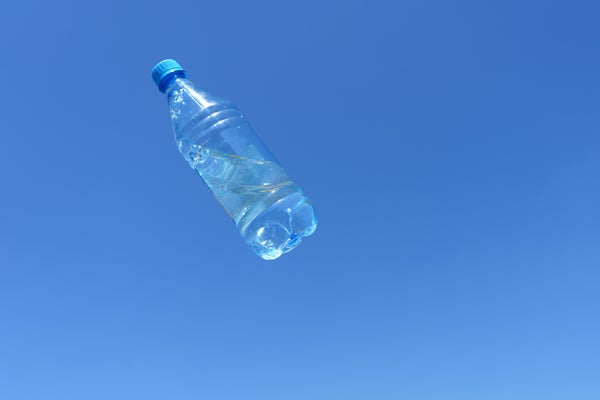
In experiments involving bouncy balls, plastic bottles and a high-speed camera, researchers in Chile discovered that it's possible to control the height of a container's bounce by swirling the water inside.
If this experiment sounds like something out of a social media challenge, that's because it is. Pablo Gutiérrez, a physicist studying fluid dynamics at Chile's O'Higgins University, became interested in bouncing containers after his son showed him the viral “bottle flip” challenge: tossing a half-full plastic bottle so it flips end over end and sticks the landing. “Pablo became very good at this challenge,” laughs Gutiérrez's co-author Leonardo Gordillo, a physicist at the University of Santiago. “He was throwing a lot of bottles.”
So the physicists and their research team took bottle flipping into the laboratory. They glued halves of rubber balls to the bottles' bottom to enhance their bounce. And they made a key observation: bottles they'd swirled before releasing bounced far less, probably thanks to fluid dynamics. To test this, the physicists built a contraption that could spin and drop bottles with scientific precision. A high-speed camera captured the drops at 2,000 frames per second. Indeed, the faster the water was swirled, the lower a bottle's bounce. The results were published in Physical Review Letters.
On supporting science journalism
If you're enjoying this article, consider supporting our award-winning journalism by subscribing. By purchasing a subscription you are helping to ensure the future of impactful stories about the discoveries and ideas shaping our world today.
“It's true. I've tried it,” says Tadd Truscott, a fluid physicist at the King Abdullah University of Science and Technology in Saudi Arabia, who was not involved in the work—but says he has tried swirling and tossing bottles by hand. “And it works quite well.”

Credit: Brown Bird Design; Source: “Swirling Fluid Reduces the Bounce of Partially Filled Containers,” by Klebbert Andrade et al., in Physical Review Letters, Vol. 130; June 16, 2023
Like car passengers during a tight turn, swirling water inside a bottle gets pushed to the sides of the container, forcing it upward evenly along the walls. When the bottle hits the ground, the spun-up water courses down toward a single point at the center of the bottle's base. “All of the fluid tries to pass through [that point] but can't,” Truscott says.
With nowhere else to go, the water flies back upward. Most of the falling bottle's momentum gets redirected into this vertical jet rather than into a bounce, dampening the impact and explaining why swirled bottles tend to stick their landings when “flipped.” The spinning water jet then flares out like a tornado and flies apart before much of it can smack the top of a bottle and cause a delayed rebound.
Truscott says he'd be interested to see whether the effect works for more viscous fluids or for larger container sizes. Such findings could perhaps be useful for mitigating collision damage to fluid-filled containers like fuel tanks. It could also make for an afternoon of fun at home; the researchers encourage readers to give a bottle a swirl and replicate the results for themselves.