
Thanks to Jaws’ pulse-pounding theme, sharks are synonymous with a spine-chilling sound. In reality, they silently swim and scarf down prey without making a peep—until now, that is.
These fish have just broken their silence. A team of researchers recently recorded sharks of one species making short, high-frequency clicks when the animals were handled underwater. The study results, published this week in Royal Society Open Science, represent the first known occurrence of a shark actively producing sound.
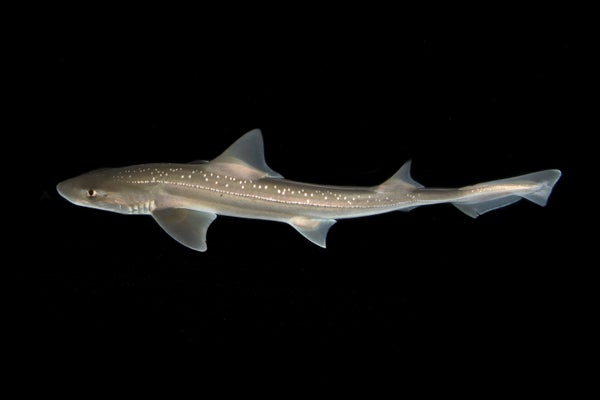
The sounds were first observed by marine biologist Carolin Nieder, lead author of the new study, while she was working on her Ph.D. at the University of Auckland in New Zealand. Her project was focused on the hearing capabilities of several sharks, including the rig shark, a small species that is native to the coastal waters around New Zealand. But something odd happened when Nieder handled the rig sharks between tests: they would start to crackle.
On supporting science journalism
If you're enjoying this article, consider supporting our award-winning journalism by subscribing. By purchasing a subscription you are helping to ensure the future of impactful stories about the discoveries and ideas shaping our world today.
“At first we had no idea what it was because sharks were not supposed to make any sounds,” says Nieder, who is now at the Woods Hole Oceanographic Institution. “I remember coming home and just thinking more and more about how weird those sounds were.”
Listen to the sharks crackle:
More than 1,000 fish species are known to produce sounds, usually by vibrating their swim bladder, a gas-filled organ that helps the animals stay buoyant and can also act as an amplifier. But rigs and other sharks lack a swim bladder.
To determine if the rigs were actually generating the crackling sounds, Nieder and her colleagues placed 10 juveniles, one at a time, into tanks that were outfitted with sound recorders. The researchers held each rig for 20 seconds and analyzed the resulting audio recordings.
Each of these sharks produced high-frequency clicks, which lasted only a fraction of a second. The researchers recorded significantly more clicks in the first 10 seconds of the handling session than they did in the last 10 seconds, suggesting the sounds represented the rigs’ response to being startled by their handlers, Nieder says.
Listen to more of the clicklike sounds:
The frequencies of the clicks were mostly outside the rigs’ hearing range, which casts doubt that the sharks use them to communicate. They do fall within the hearing range of several toothed whales that hunt rigs, however. Researchers have observed cod making similar clicking sounds to potentially spook nearby seals.
To determine how the rigs were making the clicklike sounds without a swim bladder, the team created three-dimensional reconstructions of the fish’s jaws and teeth. Rigs’ have a distinctive set of flattened teeth, which are arranged in overlapping rows to allow the animals to crack open crab shells. The team hypothesizes that the rigs’ mosaic of teeth produce the clicks as the fish snap their jaws together.
According to Dennis Higgs, a marine biologist at the University of Windsor in Ontario, the paper presents a compelling case that some sharks produce sounds. He thinks that more work needs to be conducted, however, to determine whether these sounds are part of rigs’ audible repertoire or just their response to being handled. “The open question is ‘Would the sharks make the noises in more natural circumstances?’” says Higgs, who has studied the auditory capabilities of sharks but was not involved in the new research.
Nieder agrees and plans to conduct additional behavioral experiments to learn more about what triggers the sharks’ clicks. She also hopes to conduct similar experiments with rigs and other shark species in natural environments.
Though the new paper presents the first evidence of a shark making a sound, recent research has revealed that two other types of cartilaginous fish, rays and skates, also make noise. Scientists have observed multiple species of wild stingrays in both Indonesia and Australia and rays and skates in the Mediterranean making clicklike noises when they have been approached by divers.
Sharks and stingrays diverged more than 200 million years ago. This presents the possibility that sound production is an ancient trait that is widespread among sharks and their cartilaginous kin.
“We used to think these fish couldn’t do it, but they are proving us wrong,” Higgs says. “It’s worth listening in on more shark species.”