
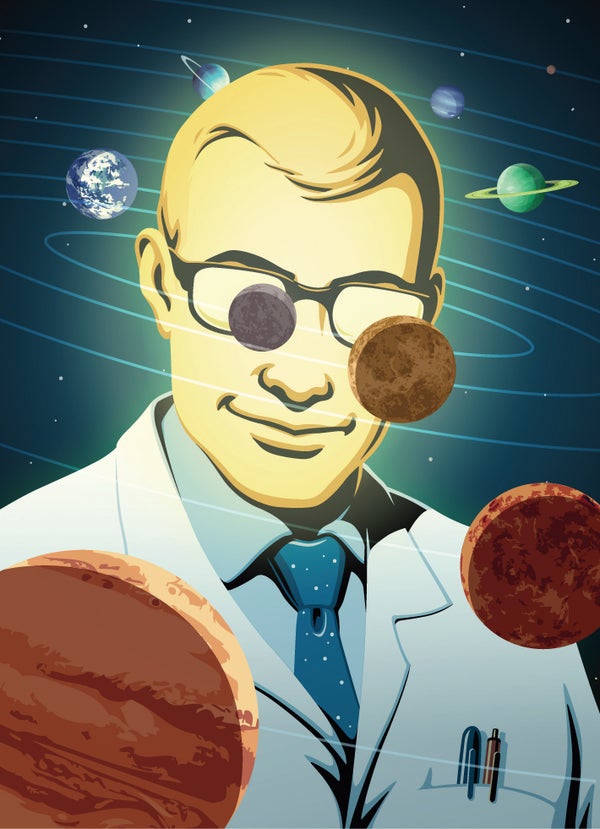
What's your mental image of a scientist? Chances are you picture not only a wild-haired, bespectacled, older man in a lab coat but also someone who is more rational, objective and intelligent than other people. Yet do scientists themselves subscribe to this stereotype?
That is the question researchers at Tilburg University in the Netherlands investigated in a study published this year in Accountability in Research. The team surveyed both scientists and highly educated nonscientists and asked them to rate the two categories of people in terms of objectivity, rationality, integrity, open-mindedness, intelligence and cooperativeness.
Both groups rated scientists higher on every one of these measures, yet scientists perceived bigger differences between the two groups than laypeople did. “That surprised us,” says psychologist Coosje Veldkamp, the study's lead author. “We expected scientists to have a more realistic picture, but they see a larger difference,” she says. (Some of these perceptions may be accurate, of course, but other research would be needed to determine that.)
On supporting science journalism
If you're enjoying this article, consider supporting our award-winning journalism by subscribing. By purchasing a subscription you are helping to ensure the future of impactful stories about the discoveries and ideas shaping our world today.
The scientists' positive self-ratings may be partly explained by the human tendency to judge members of groups we belong to more favorably than others. Further investigation showed that established scientists judged their established peers more positively than those at earlier career stages, and female scientists rated researchers of their own gender more highly. “People who identify more strongly with their group display more in-group bias,” Veldkamp explains. “Women are still a minority in science, and minority-group members have been found to identify more strongly with their group.”
Organizational psychologist Michael Mumford of the University of Oklahoma, who was not involved in the study, cautions that surveys involve self-selecting participants who are “unlikely to be representative of scientists in general.” He does not discount the results, however, given that they accord with previous research.
Veldkamp hopes that awareness of the findings may help scientists acknowledge their biases and fallibility. Scientists' overconfidence in their profession's intellectual rigor could, for instance, make them more resistant to efforts to improve the reproducibility of research. She notes that there are practices to reduce sources of bias in science—such as preregistering studies to prevent researchers from changing hypotheses and analyses midexperiment—“but we don't know how much support there is for them.” Some scientists may resist such efforts, even if they agree with them, Veldkamp says, because they “may think it applies only to others.”