
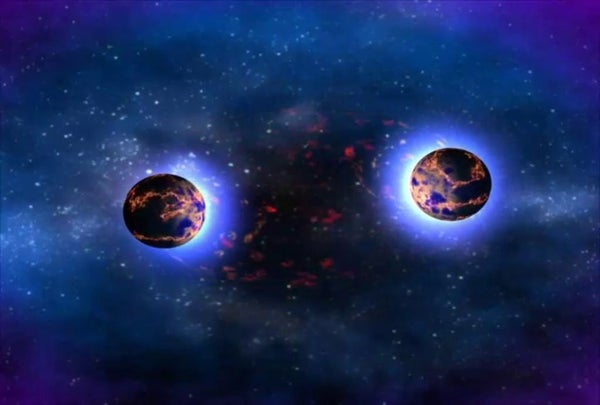
Astronomers are on the hunt for the remnants of the neutron-star collision that gave Earth its precious metals.
When neutron stars merge, they spew a wealth of short-lived elements into their surroundings, and these materials become part of later-forming solar systems. Now scientists are trying to close in on the merger that seeded our solar system by tracing the elements produced by the original decaying material. From that work, they believe the responsible merger occurred 100 million years before and 1,000 light-years away from the birth of our solar system.
“It was close,” the project’s lead scientist, Szabolcs Marka, who is a physicist at Columbia University, told Space.com. “If you look up at the sky and you see a neutron-star merger 1,000 light-years away, it would outshine the entire night sky.”
On supporting science journalism
If you're enjoying this article, consider supporting our award-winning journalism by subscribing. By purchasing a subscription you are helping to ensure the future of impactful stories about the discoveries and ideas shaping our world today.
Marka and his colleague Imre Bartos, an astrophysicist at the University of Florida, used meteorites from the dawn of the solar system to track down the collision. They analyzed the isotopes—flavors of elements with different numbers of neutrons in their atoms—in these rocks.
First, they calculated the quantity of radioactive isotopes in the early solar system; then the researchers compared their measurements with the amount of isotopes produced by neutron-star mergers. Marka presented the results of their research in January at the winter meeting of the American Astronomical Society in Honolulu.
“Our” neutron-star merger
The universe’s heavy elements, such as gold, platinum and plutonium, form when neutrons bombard existing atoms. During such collisions, a neutral neutron can emit a negatively charged electron, becoming a positively charged proton and changing the atom’s identity.
This process, known as rapid neutron capture, occurs only during the most powerful explosions, such as supernovas and neutron-star mergers. But scientists continue to debate which of these extreme events is responsible for the bulk of heavy elements in the universe.
So Marka and Bartos turned to ancient meteorites in an effort to understand which type of event may have seeded the early solar system. Locked inside of those rocks from the young solar system is material that spewed from an explosion, and although those initial elements were radioactive and rapidly decayed, they left behind signatures of their past presence.
And as the Laser Interferometer Gravitational-Wave Observatory (LIGO) begins to identify potential neutron-star mergers, scientists are applying its observations to help identify the most likely contributors of material formed in a nearby merger, what Marka called “the witch’s brew of the galaxy,” the slowly decaying material that made its way to the solar system.
Previous studies estimated that a supernova occurs in the Milky Way once every 50 years or so. LIGO’s new observations suggest that neutron-star mergers occur much less frequently, approximately once every 100,000 years. The amount of heavy elements in the solar system suggested that they came from a nearby neutron-star merger, as supernova origins would have yielded more material.
From there, the pair relied on the individual isotopes to determine where and when the solar system’s local neutron-star merger had occurred.
“Each isotope is a stopwatch starting at the explosion,” Marka said. By studying how much of each isotope was left when the material was captured, he was able to pin down the age of the collision that showered the solar system. “There is only one point in time when they all agree," he said. That point occurred roughly 100 million years before the solar system formed, an eye blink in astronomical time scales. The team also calculated how far away the stars collided, a distance of 1,000 light-years, based on how much material ended up in the solar system.
What the team could not figure out was the direction at which these heavy elements entered the neighborhood that would become our solar system, a discovery that could theoretically allow scientists to pinpoint the remnants of the collision. The problem is that the sun hasn’t been sitting still for the 4.5 billion years since it formed; instead, it’s been traveling around the galaxy.
Along the way, it has left behind the stars that formed near it in the same cluster, stars that astronomers have long hunted in vain. Marka hopes that one day, astronomers will find those sister stars and the remnants of the neutron-star merger that formed the solar system.
According to Marka, the new discovery hit close to home. “People were actually crying," he said, referring to members of his team.
He said he thinks that strong emotional reaction arose because this neutron-star merger wasn’t just an event that happened out in space. It was one that contributed to each of us, personally.
“This is not esoteric, it’s ours,” Marka said. “Not ours in the galaxy but ours in the solar system.”
Copyright 2020 Space.com, a Future company. All rights reserved. This material may not be published, broadcast, rewritten or redistributed.