New Issue: Orbital Catastrophe Ahead? Read Now

Scientists Unearth Mysterious Meteorite Crater in China

Thousands of years ago, a space rock hit what is now China, leaving a bowl-shaped crater some 900 meters wide

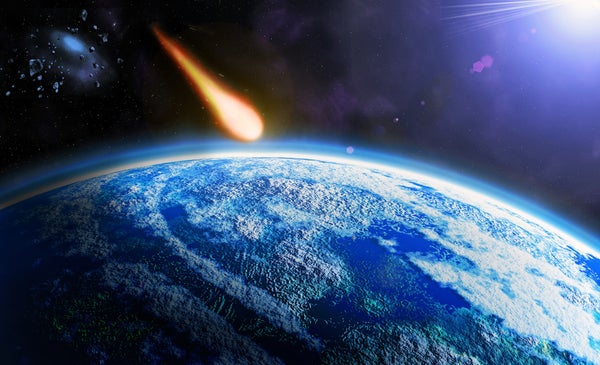
A bright orange streak of a meteor heads toward the blue and white Earth, with the sun's light shining on the scene from the top right corner

PaulPaladin/Getty Images

Join Our Community of Science Lovers!

Scientists have discovered a massive asteroid impact crater in China. The bowl-shaped depression is some 900 meters wide—more than eight times the length of a football field.

In a paper published last month, the researchers behind the discovery said the structure, named the Jinlin crater, was likely formed by a meteorite hit during the early to mid-Holocene, a geological epoch that started just 12,000 years ago. The findings were published online on October 15 in the journal Matter and Radiation at Extremes.

The analysis is intriguing, but several experts cautioned that more research is needed to confirm that time line.

“The Holocene age estimate is only inferred and not measured, so the age is very uncertain,” says Mark Boslough, a research professor at the University of New Mexico, who was not involved in the study.
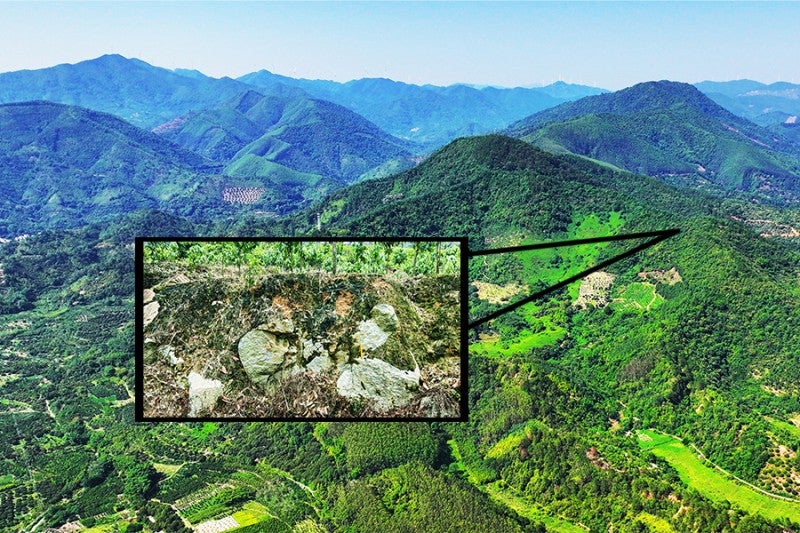
A panoramic aerial drone image of the Jinlin crater with the approximate location of the crater rim labeled, with an insert of the crater floor, which shows a mix of granite weathered soil and granite fragments.

A panoramic aerial drone image of the Jinlin crater with the approximate location of the crater rim labeled, with an insert of the crater floor, which shows a mix of granite weathered soil and granite fragments.

Ming Chen


On supporting science journalism

If you're enjoying this article, consider supporting our award-winning journalism by subscribing. By purchasing a subscription you are helping to ensure the future of impactful stories about the discoveries and ideas shaping our world today.


Other experts are more sanguine: Geologist Steven Jaret says the team only suggested that the impact most likely occurred during the early to middle Holocene—an estimate supported by the data in the study. Jaret, who was also not involved in the study, emphasizes that the researchers agreed that more work would be needed to precisely date the crater. Scientific American has reached out to the authors for comment.

The team analyzed chemical and physical weathering rates to come up with its age estimate. These measurements are often error-prone, however, Jaret says.

A more precise method would be to measure the rate of decay of radioactive isotopes in the rocks, such as those of the element argon. But this is time-consuming and extensive, Jaret says.

“A lot of times, you need to justify doing the next step,” he says.

Subscribe to Support Independent Journalism

Great science journalism requires human expertise, time, effort and creativity. And it costs money. That’s why I and the journalists here at Scientific American hope you’ll join our community.

When you subscribe, you are supporting staff and freelance journalists who are passionate about telling science stories that are true, important and compelling. Our editors and reporters are often experts in their fields, which means they understand the nuances of big discoveries and can untangle the breakthroughs from the hype. With a subscription, you are also supporting rigorous fact-checking to ensure the words we publish are precise and accurate. And you’re supporting original illustrations, graphics and photos that bring you closer to an advanced laboratory, an ice sheet in Antarctica or a space mission in orbit. You’re helping us craft other types of high-quality journalism as well: Our newsletters are carefully written, edited and curated by staffers you have or will come to know and love. Our Science Quickly podcast is based on original reporting, collaboration with editors and scientists and exacting production.

Subscriptions keep this engine running so we can continue to deliver thoughtful, rigorous and independent science journalism to you. In an era of viral misinformation, this work is crucial. If you value what we do, I hope you’ll consider joining us as a subscriber

Thank you,

Jeanna Bryner, Editor in Chief, Scientific American

Subscribe