

By Steve Gorman
LOS ANGELES, June 28 (Reuters) - Marine mammal rescue teams alerted boaters off Southern California on Tuesday to be on the lookout for a blue whale ensnared in the rigging of a commercial crab trap, a day after initial efforts to free the giant creature failed.
Rescuers spent an entire day trying to cut free the 80-foot-long (24-meter-long) whale on Monday, ending the operation around nightfall, and hoped for a second chance at disentangling the distressed animal, authorities said.
On supporting science journalism
If you're enjoying this article, consider supporting our award-winning journalism by subscribing. By purchasing a subscription you are helping to ensure the future of impactful stories about the discoveries and ideas shaping our world today.
As of late Tuesday, the whale and a tell-tale string of yellow-and-orange buoys trailing behind it remained out of sight, said Gisele Anderson, whose husband, Dave, runs a fleet of whale-watching excursion vessels involved in the effort.
The whale was spotted about 30 miles (48 km) off San Diego over the weekend and again on Monday near Dana Point, about 65 miles (105 km) to the north, by the crew of Captain Dave's Dolphin and Whale Watching Safari, Anderson said.
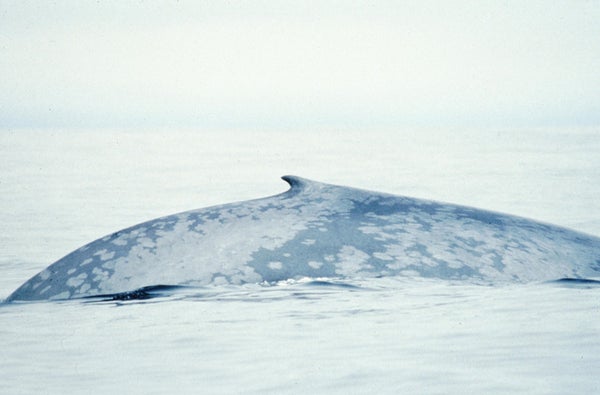
Blue whales, an endangered species, grow up to 100 feet (30 meters) in length and weigh close to 200 tons, ranking as the largest living animals on Earth.
Whale entanglements are not uncommon, and can prove lethal, according to Michael Milstein, a spokesman for the National Oceanic and Atmospheric Administration (NOAA).
"The animal has to work that much harder pulling that gear around for it to survive," Milstein said. "It's going to be a long-term debilitating problem for the whale if it doesn't get free."
Last year, 61 whales were found caught in fishing gear, crab pots and netting and nearly 40 have been reported so far this year along the U.S. West Coast, Milstein said.
Most are gray and humpback whales, which tend to swim closer to shore, while blue whales are more common in the open ocean, according to Milstein.
He said the blue whale encountered near Dana Point was only the second one ever reported ensnared off the West Coast, and the first rescuers have tried to free.
Two buoys attached to the entanglement identified it as part of a crab trap from Morro Bay, off central California, Anderson said. The harness was stuck in the whale's mouth and was dragging the heavy main rigging of the trap beneath the animal, encumbering its ability to swim and feed, she said.
The whale-watching boat crew, joined by NOAA officers, local harbor patrol and sheriff's deputies, spent hours trying to slice away the entanglement using cutters on long poles when the whale surfaced to breathe.
The effort grew more difficult as the animal appeared to become agitated and began submerging for longer periods of time, Milstein said. (Reporting by Steve Gorman; Editing by Marguerita Choy and Sandra Maler)