See Every Bit of Outer Space We’ve Brought Back to Earth
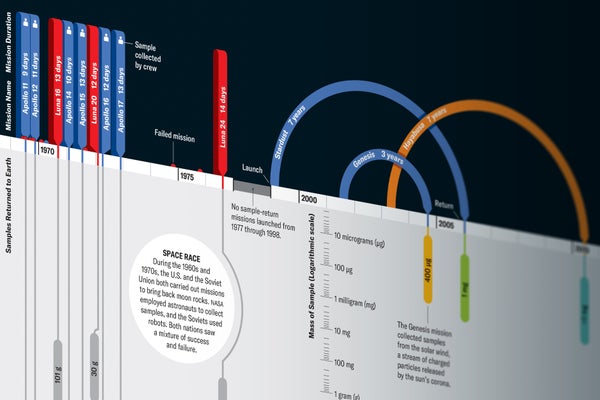
Sample-return missions have brought piles of moon rocks, plus pieces of asteroids, comets and even the sun back to Earth. Next up is the big prize: Mars
Visiting moons, asteroids and planets is great, but taking a piece of them home is even better, according to traditional space wisdom. Bringing samples to Earth allows scientists to study them with the full breadth of existing laboratory technology, whereas only limited analyses are possible on other worlds. Yet retrieving samples from such locations requires not just getting there but launching off the surface and getting home, too. “It’s hard to do, and as a result, it hasn’t been done very often,” says space historian Roger Launius.
Although humans have sent 10 successful landers to Mars, no one has yet brought bits of Mars to Earth. That could change in the coming decade, though, as NASA and space agencies in Europe, China, Russia and Japan have proposals in the works to achieve this milestone. NASA's Perseverance rover has already collected samples on the Red Planet in preparation for a future retrieval mission.
Credit: John Knight
On supporting science journalism
If you're enjoying this article, consider supporting our award-winning journalism by subscribing. By purchasing a subscription you are helping to ensure the future of impactful stories about the discoveries and ideas shaping our world today.
Subscribe to Support Independent Journalism
Great science journalism requires human expertise, time, effort and creativity. And it costs money. That’s why I and the journalists here at Scientific American hope you’ll join our community.
When you subscribe, you are supporting staff and freelance journalists who are passionate about telling science stories that are true, important and compelling. Our editors and reporters are often experts in their fields, which means they understand the nuances of big discoveries and can untangle the breakthroughs from the hype. With a subscription, you are also supporting rigorous fact-checking to ensure the words we publish are precise and accurate. And you’re supporting original illustrations, graphics and photos that bring you closer to an advanced laboratory, an ice sheet in Antarctica or a space mission in orbit. You’re helping us craft other types of high-quality journalism as well: Our newsletters are carefully written, edited and curated by staffers you have or will come to know and love. Our Science Quickly podcast is based on original reporting, collaboration with editors and scientists and exacting production.
Subscriptions keep this engine running so we can continue to deliver thoughtful, rigorous and independent science journalism to you. In an era of viral misinformation, this work is crucial. If you value what we do, I hope you’ll consider joining us as a subscriber
Thank you,
Jeanna Bryner, Editor in Chief, Scientific American