
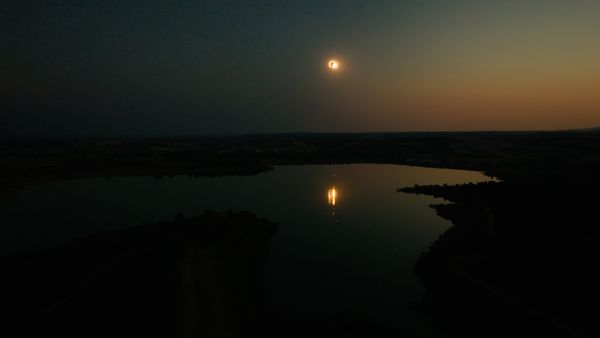
Sky-gazers have been captivated by the 2026 total solar eclipse, the first of its kind to pass over mainland Europe in some three decades.
On August 12, for a few brief moments, about one billion people across Europe, North Africa, North America and the Arctic experienced partly or fully dark skies as the moon passed directly in front of our star, blocking its light.
On supporting science journalism
If you're enjoying this article, consider supporting our award-winning journalism by subscribing. By purchasing a subscription you are helping to ensure the future of impactful stories about the discoveries and ideas shaping our world today.
The path of totality—the region with the greatest view of the solar eclipse—passed over northern Russia, Iceland, Greenland, Spain and parts of Portugal. For anyone inside the path of totality, dramatic changes could be seen in the moments before the moon covered the sun, creating a false twilight.
Scientific American contributor and eclipse chaser Lucie McCormick was on the ground in Spain near its capital of Madrid. From there, she captured several stunning images of the total solar eclipse as it passed over the skies. In this image, you can see the fiery red of a solar prominence on the left edge of the sun—a huge, bright structure made of plasma that follows a tangled web of magnetic fields looping up from the sun's surface into its corona.

A view of the total solar eclipse from Spain on August 12, 2026.
Lucie McCormick
Parts of the U.S. experienced only limited partial eclipses. Still, sky-gazers captured the International Space Station passing in front of the partially eclipsed sun in the sky over Maine.

The International Space Station, with a crew of seven onboard, is seen in silhouette as it transits across the sun at roughly five miles per second on August 12, 2026, from a view near Hodgdon, Me.
Joel Kowsky/NASA via Getty Images
Viewers in Berlin and London were greeted with a partial eclipse, meaning the moon did not fully cover the sun.

The partial solar eclipse is pictured on August 12, 2026, in Berlin.
Florian Gaertner/Photothek via Getty Images
In London, the eclipse was framed by the Great Bell of the Great Clock of Westminster, better known as Big Ben.

The Elizabeth Tower, including and often referred to as Big Ben, in central London is pictured during a near-total solar eclipse, with more than 90 percent of the sun blocked by the moon across the U.K., on August 12, 2026.
Toby Shepheard/AFP via Getty Images
And in Italy, players at AC Milan soccer club would have seen this pinkish crescent of the sun as the partial eclipse occurred over their practice session on Wednesday.

The solar eclipse at the Milanello Sports Center after an AC Milan training session on August 12, 2026, in Cairate, Italy.
Photo by Claudio Villa/AC Milan via Getty Images
As the moon slid into place over the sun, onlookers may have seen Baily’s beads—flashes of sunlight shining through valleys along the moon’s rugged limb.
The beads quickly faded as the sun’s face disappears completely behind the moon. In this moment, the sun’s faint outer atmosphere, its million-degree-Celsius corona, blazed into view. Usually hidden by the glare of our star, the ethereal corona and its pale, wavering streams of plasma are shaped by the sun’s magnetic field.
This screenshot shows the moment of totality from the European Space Agency's livestream of the eclipse at the Astrophysical Observatory of Javalambre in Spain. Again, the solar prominence can be seen in red.

A screenshot of the European Space Agency solar eclipse livestream shows the sun’s corona at the moment of totality.
Screenshot from YouTube/ESA
Editor‘s Note (8/12/26): This is a developing story and will be updated.