
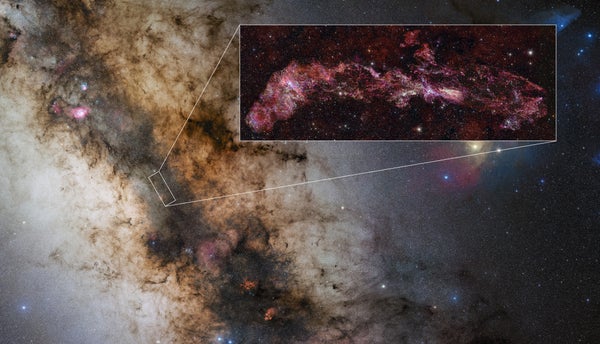
In the heart of the Milky Way galaxy, there is beauty in chaos. There dense clouds of dust and spindly filaments of cold molecular gas, the basic matter from which stars form, encircle the galaxy’s central supermassive black hole, Sagittarius A*. And now a new image reveals that beauty in unprecedented detail.
Taken using the Atacama Large Millimeter/submillimeter Array (ALMA), the image displays our galaxy as a “place of extremes, invisible to our eyes, but now revealed in extraordinary detail,” said Ashley Barnes, an astronomer at the European Southern Observatory (ESO) in Germany, in a statement.
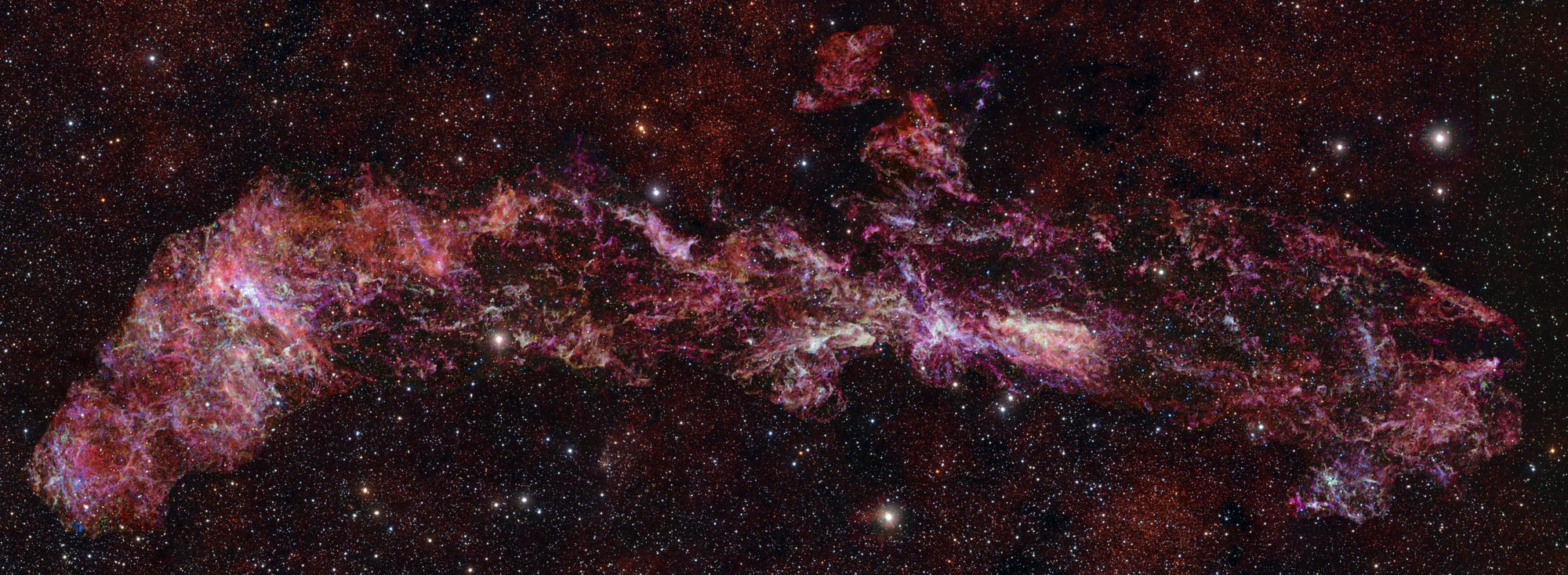
ALMA(ESO/NAOJ/NRAO)/S. Longmore et al. Background: ESO/D. Minniti et al.
On supporting science journalism
If you're enjoying this article, consider supporting our award-winning journalism by subscribing. By purchasing a subscription you are helping to ensure the future of impactful stories about the discoveries and ideas shaping our world today.
The image captures an area more than 650 light-years across in what is known as the central molecular zone (CMZ). Inside lurk gas structures that span many dozens of light-years and the smaller clouds that envelope stars. Astronomers are particularly interested in the zone’s chemistry because its gas feeds into the matter from which stars grow.
Studying this region of the Milky Way can offer clues as to how galaxies like our own formed, said Steve Longmore, an astrophysicist at Liverpool John Moores University in England, in the same statement. “We believe the region shares many features with galaxies in the early Universe, where stars were forming in chaotic, extreme environments,” added Longmore, who is also part of the team that captured the new observations.
The image, which is the largest ever captured by ALMA, is part of the ALMA CMZ Exploration Survey. The new data were described in several papers that were posted on the preprint server arXiv.org and accepted for publication in the Monthly Notices of the Royal Astronomical Society.